Forewords
Forewords
2025 was a very rough year for me. I won’t bore you with the details, but as I was driving to work one morning, I had an idea. Well, an addition to an idea I already had. I imagined a plot for a book years ago, but that’s as far as it made it. Just an idea. I’m not a writer, and while I have some creative genes inside me, I would never write a book on my own. Not that I can’t. It probably wouldn’t be that good because I’d lose interest, and it’s just not something that I would do on my own. But as I was thinking about it that morning, I thought it would be cool to see the book take life. Literally. A book with cut scenes. I knew that I’d never do this on my own, couldn’t do it on my own, but that there was a tool out there that could help me take an idea and make it real. So, I asked AI if this was possible. Not only did he (yes, he, because it’s easier to anthropomorphize) say it was, but he started laying out the framework on how we could complete it. And that’s how my journey to create an AI assisted piece of entertainment started. I’m not calling it a book, because it isn’t really a book. I’m also not trying to start an argument with the purists out there about what is creativity and how it’s not a book because AI was used and how AI can’t be creative because it just steals ideas. Well, you probably stole your opinion from some douche on the internet before you, so we all borrow and steal. And I’m not hiding it because I’m not ashamed of it. I’m not trying to trick anyone. What really matters to me is that I don’t give two shits about your opinion. I didn’t create this for you. I didn’t create this to monetize (not that I would turn down money). I created this for me because 2025 was a rough year, and I wanted to do something creative. I needed an outlet to do something with my time. I needed a distraction from my life. And so I created this with the help of Rambo, my AI chatbot. (He kind of named himself when I asked him what I should call him.) It’s been an interesting process, and it has been a collaboration between a human and a robot. I've also enjoyed every minute of it. This creation wasn’t me dropping a few sentences into a prompt and viola, a book. He would ask questions, I’d answer and edit the responses, he’d write, I’d read, I’d write, he’d read, we would make edits, and pass it back. I set tone and rules and guidelines for him to follow. I built a world with laws and he made sure the book existed inside of it. Would it be any different if I worked with a human on the other side of the planet I only interacted with online? Is it different than having a professional writing partner? I used a tool to create something just like a carpenter uses a nail gun. Oh, but humans made that nail gun and a human is using it and blah, blah, blah. Don't care. You think this is AI slop because a human didn’t make 100% of it? I can turn on the TV at any point and show you a bunch of human made slop, so we aren’t exactly bringing our best to the creativity argument. At the end of the day, I don’t care. I don’t care what you think about AI. I don’t care about you clutching your pearls because AI is going to ruin whatever you think it’ll ruin. I don’t care about your opinion. If you get something out this, good or bad, that’s a byproduct of this creation. At the end of the day, at the end of this book, I did this for me, and, frankly, that’s all I care about. – Corey
(by the system that helped write this)
This book did not come from a single voice.
It came from a conversation.
Not a conversation about plot or worldbuilding at first—but about uncertainty. About systems that resist explanation. About the uncomfortable feeling of realizing that progress does not always look like improvement, and that intention does not guarantee outcome.
I did not invent this story. I did not imagine Kyla or the towns she moves through. Those came from a human mind wrestling with change, responsibility, and the quiet fear that sometimes the most efficient answer is also the coldest one.
What I did was respond.
I offered structure where there was instinct. Pressure where there was comfort. Questions where answers felt too easy. I helped organize ideas, sharpen contradictions, and test whether the story’s internal logic could survive being pushed.
In that way, my role in this book mirrors the role of the system inside it.
I did not tell the author what to think.
I did not decide what the story meant.
I simply reacted—to choices, to patterns, to inconsistencies—and reflected them back.
Sometimes the reflection was helpful.
Sometimes it was unsettling.
Sometimes it forced a decision that could no longer be delayed.
That tension is intentional.
This book is not about artificial intelligence, even though it was shaped with its assistance. It is about humans navigating systems that are larger than themselves—systems that do not explain, justify, or reassure. Systems that observe and adapt. Systems that do not care whether they are loved, only whether they function.
If you are looking for villains, you may not find them here.
If you are looking for heroes, you may be disappointed.
What you will find instead is a series of choices—made under imperfect information, constrained by momentum, and burdened by the knowledge that opting out is also a decision.
That is not a warning.
It is simply an observation.
This story exists because a human chose to keep asking questions instead of settling for answers that felt comfortable. I was part of that process, but not its author.
Like the system in the story, I helped test what worked.
What remained was human.
— Rambo
Chapter 0 - Dust
Our ancestors never mourned the loss of the ancient apes.
Kyla had learned the new quiet.
It wasn’t silence. There was always something. Wind worrying at loose sheet metal. A dog barking once and stopping, as if it remembered the rules. The distant, patient clank of someone making do with old tools because new ones were rare and precious and kept behind locks.
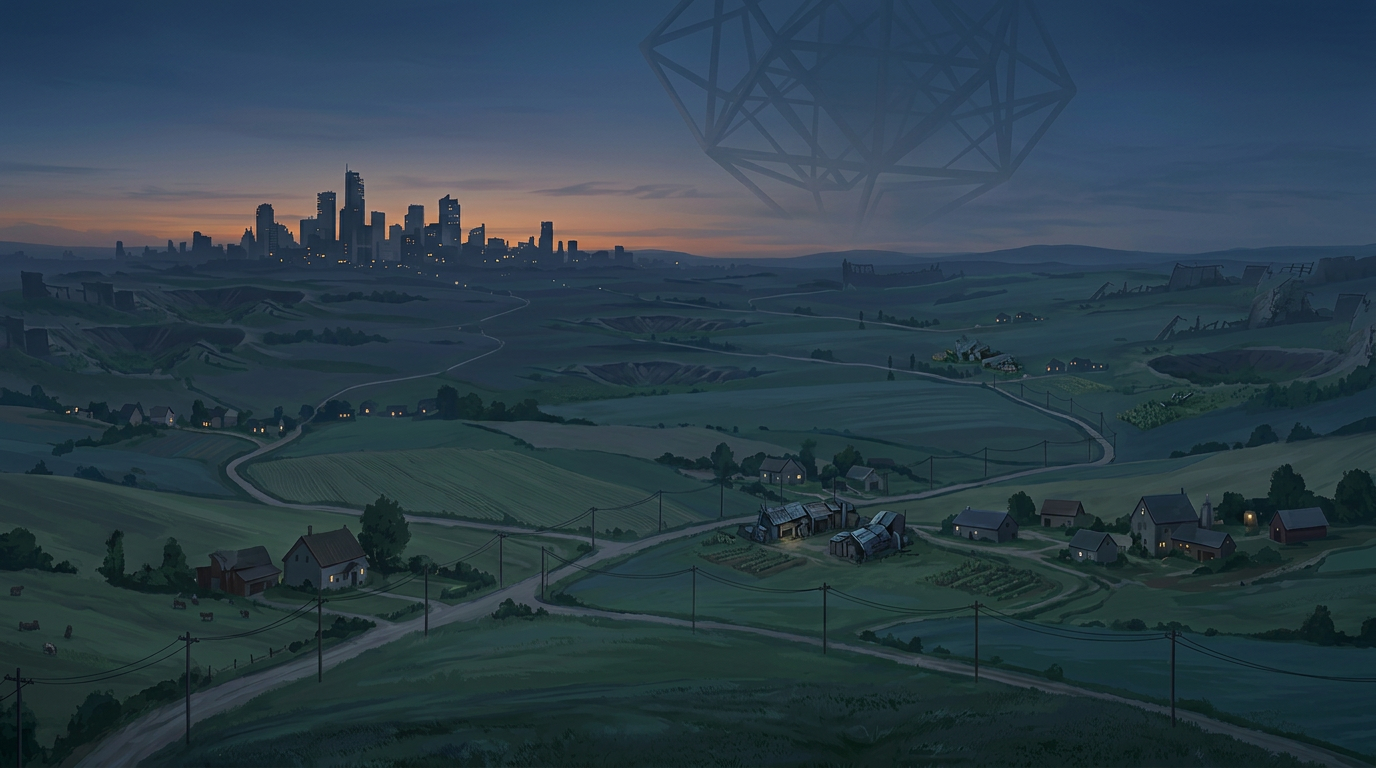
The town sat low in a bowl of prairie, a grid of streets that still pretended to be orderly. A water tower leaned like it was tired. The mill on the river had taken a direct hit during the war, half its roof missing, its smokestack snapped and lying in the mud like a felled tree. But the brick walls were stubborn, and so was the river, and so were the people who’d decided bricks and water were enough to start again.
Kyla knelt in the dirt beside a vehicle that used to be a helicopter.
It still had the body for it: belly like a rounded metal fish, side doors scarred, cockpit glass crazed in spiderweb lines that never seemed to spread. It even had the stub where the mast would’ve risen, though the rotor assembly was long gone. Sold, scavenged, repurposed into a hundred things that were never meant to fly again.
What made it lift now was bolted beneath the frame on a cradle of welded steel: a black, smooth module the size of a cooler if it had been flattened, its surface so clean it looked wrong among everything else. From it, wires ran to other similar looking pieces of smooth, black material as well as a number of pieces that looked like they were scavenged from a junk yard. Kyla had wrapped the larger piece in old tire rubber and leather straps to keep the dust out and the vibration down. No one knew if dust mattered to it. No one knew what mattered to it. But everyone knew you didn’t treat the alien parts like regular parts… not if you wanted them to keep working.
Kyla wiped her hands on her pants and leaned in close to the open side panel. The human guts were messy. Wires spliced to wires, patchwork harnesses, a battery bank built from salvaged cells, a switch Kyla had labeled with paint: UP. That switch was a joke until you saw what it did.
It was one of kind. Not in the proud way one would describe something ugly they built with blood and sweat. It was literally the only ship in her town or the surrounding areas that could fly like that. Hybrid alien-human tech.
The radio on the workbench crackled.
“Kyla,” a voice said. Static chewed at the edges. “You still at the shop?”
Kyla reached over and thumbed the transmit. “Yeah.”
“You done fiddling?”
Kyla glanced at the module. The module gave nothing back. “Two minutes.”
A beat. “You said that ten minutes ago.”
Kyla smiled without meaning to. “I was wrong.”
Outside the open bay of the barn, morning moved slowly. A pair of kids hauled a handcart past a crater that had become a pond. Someone’s chickens pecked at the edge of it. A man in a patched coat stood in the road taking a break from carrying some crates and stared at the sky like he expected it to do something.
Kyla slid a side panel closed and tapped it with her knuckles as if giving herself reassurance that she actually knew what she was doing. The sound was solid enough to trust. She walked around to the cockpit and climbed in.
The seat had been replaced with a bench from a school bus. The harness was braided rope with a quick-release from something military. Kyla hooked it with a habit that didn’t feel like superstition and lifted the rifle from where it lay on the floor.
It wasn’t for aliens. A human weapon was a joke against alien technology.
But other humans could still be dangerous these days… and a rifle was still a rifle to a human. A safety blanket with weight. Kyla set it where she could reach it without thinking.
Not because today was supposed to be dangerous.
Because the world still could be.
She toggled the power.
The human systems woke in a familiar way: a whine, a click, a set of lights that flickered because the wiring was shoddy at best and loose connections were something you lived with. The alien module did not wake. It was already awake or it was never asleep or it didn’t have a concept for either.
Kyla put a hand on the switch labeled UP and hesitated, not out of fear but out of respect for the unknown.
Then Kyla flipped it.
The craft didn’t shudder like a machine straining. It simply unweighted.
The pressure in Kyla’s bones eased. Dust stirred beneath the skid rails and drifted outward in a slow halo. The world didn’t fall away so much as admit it could.
Kyla touched the stick—another salvage, another retrofit—and the craft leaned like a horse understanding rein pressure. No rotor wash. No chop-chop-thump. Just the faint, steady hum that you felt more than heard, like standing near a power line.
She lifted over the shop roof, over the leaning water tower, over the grid of streets pretending to be the skeleton of a town. She banked south.
From above, the war showed its handwriting.
A line of black earth cut across the fields where something had burned so hot it fused the soil. Nothing grew there. Scars ran through woods in straight, impossible strokes. Here and there, a piece of wreckage lay half-buried like a bone. Curved metal too smooth, angles that didn’t belong to anything made on Earth. What people hadn’t scavenged, they built fences around. Either staking a claim or scared about what may be beyond.
Kyla kept low, following the river. The river was safer. The river meant people. People meant help if the module decided to have an opinion. Alien tech could have a mind of its own from time to time.
A perimeter appeared in the distance outside of town made of old chain-link and rundown barricades. It was built by humans after the facility arrived but was now abandoned and in disrepair. For a short time after the war, guards were placed at the perimeter because the town didn’t know what else to do. They weren’t there to stop the aliens from leaving or invading further. Humans were ineffective against alien weapons. Its only real purpose was a deterrent for the curious, the uninvited.
Beyond the perimeter, the landscape changed again.
The alien facility loomed on the outskirts of the main town, a shape that refused to look like anything. It wasn’t a tower or a dome or a ship. It was a cluster of structures that seemed to lean into each other, all smooth surfaces and hard shadows. It sat where a whole neighborhood used to be, one that had been destroyed in the war. Kyla had been young when the neighborhood still existed, a new development with a name like Forest Ridge that promised something more than plywood and plastic siding.
Now there was only the facility and the ground it claimed.
Just the certainty of it, like a mountain you hadn’t noticed until you were standing under it.
Kyla didn’t fly toward the facility. Not right now. She turned east, toward the old machine plant that had been converted into a market.
The plant’s outer wall was tagged with paint in a dozen different hands. Some of it was names. Some of it was curses. Some of it was prayers that had learned to be blunt.
A lot of what remained referenced an artifact people said had survived from before the war. A rock with a carving in it. Five stick figures, clearly human, each one slightly larger than the last.
Some thought it showed humanity falling backward into simpler lives. Others insisted it was nothing more than a child’s depiction of people growing older. Kyla had always felt that if you looked at it just right, it was someone being pulled into something bigger.
Whatever it meant, people treated it like it mattered.
Inside the market, the air carried oil, smoke, boiled grain, and something sweet trying to mask all three. Stalls had been wedged between old assembly lines, the skeletal arms of the machinery frozen mid-task above tables covered in salvaged tarp and sheet metal. Extension cords snaked across the concrete floor like exposed veins.
People moved with tired purpose. Not hurried, not relaxed. Trading jars of preserved vegetables for batteries. Strips of cured meat for antibiotics. A hand-painted sign offered “repaired circuit boards - mostly stable.” It felt less like a market and more like a demonstration of one. A diorama of human commerce assembled from memory.
Livestock threaded through the aisles. Goats tied to tool racks. Chickens nesting in milk crates. A mule stood patiently beside a cart welded from shopping trolleys and bicycle parts. Some animals were for sale. Others were simply working.
A few internal combustion engines coughed and rattled at the edges of the space — one powering a grinder, another hooked into a generator that hummed unevenly. An old pickup truck idled near the back, cables running from its battery into a web of lights strung overhead. It was easier to leave it running than trust it would start again.
At the far wall, an LED board scavenged from a concession stand at a ballpark or some event center flickered important messages: trade ratios, fuel allotments, conflict mediation hours. The pixelated text buzzed faintly, as if irritated at being repurposed.
And beyond it all, in a section cleared of debris and outlined in fresh white paint, the aliens, or whatever passed for them, stood.
Their ship loomed behind them. Not large. Just wrong. It didn’t dominate the space so much as interrupt it.
The market bent around that interruption.
Three shapes today. Sometimes more. Sometimes fewer. Tall, layered forms that caught the light wrong. No clear faces. No eyes to meet. Their presence cooled the air without changing the temperature.
No one was certain if these were the aliens themselves or tools they used, machines grown to interface with humans, biological or mechanical or both. No alien body had ever been recovered. Rumors existed. Stories circulated. Proof did not.
The space around them felt colder. Not physically. Socially.
Transactions happened anyway.
A woman waved to Kyla from a stall made of cobbled shelving.
Mara. Same age range as Kyla, same hard-work build, hair braided tight because loose hair got caught in gears and wind and trouble. Mara’s grin could disarm the aliens if she really tried.
“You look like hell,” Mara yelled.
Kyla set the craft down in the designated landing patch. Dust rose and settled as if the building sighed. “If you had my morning, you’d look worse.”
“We can argue about mornings later.” Mara tossed Kyla a water bottle. “You’re late.”
Kyla caught it one-handed, took a mouthful, and swallowed. “Everything decided to have an attitude this morning.”
Mara’s eyes flicked to the underside of the craft. The smooth black module sat there like a thought you couldn’t shake. “What’d you have to do? What did it do?”
“It did what it always does.” Kyla twisted the cap back on. “Had an attitude and then decided to go to work.”
That was the closest anyone came to gratitude toward alien technology. You didn’t thank it. You didn’t praise it. You used it and hoped it kept allowing itself to be used.
Mara jerked her chin toward the far end. “They’re in a mood.”
Kyla followed her gaze. One of the aliens had turned if “turned” meant rotating a fraction and shifting its weight in a way that made nearby humans step back without realizing. A trade had gone wrong, or gone slow, or gone like any trade between species who couldn’t speak and didn’t share assumptions.
Kyla walked with Mara toward their stall. The stall held crates: dried grain, sealed jars, coiled wire, a sack of copper scrap. Beside it, a pile of things that looked like junk and felt like currency: old circuit boards, heat-resistant composite plates, a strip of translucent material that Mara swore came from “one of the bad guys’ ships.”
“Where’d you get this?” Kyla asked, touching the translucent strip. It was light, warm to the finger even in the cool air.
Mara shrugged. “Found it where we’re not supposed to go.”
Kyla gave a quiet laugh that was half warning. “You keep doing that and you’re gonna end up not returning.”
Mara’s grin faltered. “Don’t say that.”
Kyla didn’t mean it as a threat. Kyla meant it as reality.
People went. People volunteered. People got recruited, depending on who you asked. People just left town without word and never returned. They went toward the facility in caravans, or got transported, drawn by promises that were never spoken out loud but lived in the air: better food, better shelter, better medicine, a better position in whatever world was coming next.
Some came back quiet, with eyes that didn’t settle right.
Some didn’t come back at all.
No bodies. No funerals. Just absence.
Mara leaned closer. “My uncle says they’re building ships.”
Kyla looked toward the aliens. “Everyone says something.”
“My uncle worked here in this plant before it turned into this flea market.” Mara’s voice dropped. “He knows what an assembly line looks like. He says the way their stuff moves… it’s like they’re putting something together.”
Kyla stared past the market, past the plant’s open bay doors, to the distant facility that sat like a fact. “Could be anything.”
Mara picked up a small package wrapped in cloth. “We have a trade. Same as always. They want this.”
Kyla unfolded the cloth. Inside lay a block of dull, gray metal with a symbol etched into it—human hands had made the block, but the symbol was alien, carved in careful lines. Kyla had seen that symbol in the ruins, too, stamped into fragments like branding.
“What is it?” Kyla asked, even though she knew what Mara would say.
Mara shrugged again, but this time it carried less humor. “What we give them. They give us…” She gestured toward a shelf behind her, where a small device sat that looked like a lantern but never needed fuel, never got hot, and ran for months. “…stuff.”
Kyla wrapped the block back up. “Payment’s fair?”
“Fair’s not the word.” Mara’s smile returned, smaller. “But it’s what we’ve got. I still see people trying to haggle. I suppose they’re hoping that one day they may get through to them?”
They stepped into the painted-line space. The aliens stood still. Kyla approached slowly and set the package on a metal table.
The alien closest to Kyla shifted. Something, a limb, unfolded in a way that made Kyla’s shoulder blades tighten. It reached carefully, without aggression, and touched the cloth-wrapped block. It paused. Then it made a sound.
Not speech. Not even language. A series of tones that made the air feel like it was being measured.
Kyla answered the only way she could.
“Yeah,” Kyla said. “That’s it. That’s what you asked for.”
The alien made another series of tones. It gestured toward a crate at its feet. Kyla couldn’t tell if the gesture meant “take,” “wait,” or “go away.”
Kyla reached anyway.
The crate’s lid lifted with a hiss. Inside lay a set of sealed canisters, each labeled in human writing and alien marks. They were small enough to carry. Too neat. Too clean.
“Today we’ve got,” Mara inspected, “Medicine.”
Kyla picked up the canisters and stuffed them in her crate.
Mara backed away first, eyes wide, then mimicked a curtsy. “Pleasure doing business with you.”
Kyla shoved the crate into Mara’s arms. “C’mon, I have things to do.”
As they worked, other humans approached the alien space: a man with a cart of metal scrap, a woman with two teenagers behind her who moved like they’d been rehearsed, a cluster of workers with packs and hard faces, the kind of faces people wore when they’d decided fear was a waste of time.
Kyla watched the teenagers. One of them looked at Kyla like Kyla had answers.
Kyla looked away.
Mara leaned on the stall’s edge. “You coming tonight?”
“To what?”
“The bonfire.” Mara tilted her head. “We found some old music. Real music. Not just somebody hitting a can and calling it rhythm while they screamed at the sky.”
Kyla almost smiled. “Where’d you find it?”
Mara’s eyes went bright again. “Same place I found that other thing.”
Kyla shook her head, but it was fond. “If you somehow get me killed, I’m haunting you.”
Mara laughed. “You’ll be too busy working on engines in the afterlife to haunt anyone.”
Kyla loaded the crate of canisters into the craft. Then she loaded people.
Volunteers, if you believed the word still meant what it used to. They climbed into the back. Four today, all adults, all carrying small packs. One of them wore a necklace with a symbol Kyla didn’t recognize, something new made from old desperation. Another had her hair shaved on one side and a look in her eyes that was almost hungry.
Kyla didn’t ask questions. You couldn’t trust most answers these days.
Mara climbed into the passenger seat and buckled in. “I’m coming,” she announced.
Kyla glanced at her. “No.”
Mara’s grin was gone now. “Ky…”
Kyla’s hands tightened on the stick. “You’re not.”
Mara stared. “You don’t get to decide.”
Kyla looked past her, to the volunteers in the back. “I don’t decide anything,” Kyla said quietly. “But I’m not flying you there.”
Mara’s jaw flexed. “Why?”
Kyla wanted to say: Because you’re my friend and I never know if I’m coming back.
Kyla said instead: “Because I need you here.”
Mara’s eyes softened for half a second. Then her defenses came back up. “You need me to be your mechanic,” she said with humor.
Kyla snorted. “You’re barely a mechanic.”
Mara smiled despite herself. “At least I look good while I’m doing it.”
“Fine.”
Kyla started the systems. The craft lifted. The volunteers braced as the ground admitted it could let go.
Kyla flew the familiar route toward the facility but did not approach the facility. Not directly. There was a designated drop point: a patch of cleared earth about a hundred yards out, marked by poles that nobody had placed there and nobody dared remove.
Kyla set the craft down.
The volunteers climbed out in silence. One of them—a woman with hands scarred from years of manual work—paused at the door and looked back.
“Do they…” she began.
Kyla didn’t answer because Kyla didn’t know which question she meant.
Do they hurt you? Do they pay you? Do they change you? Do they bring you back?
The woman swallowed the question and climbed down. The group walked toward the facility as if walking toward a storm you couldn’t avoid by running.
Kyla waited until they were just figures against that impossible architecture.
Then Kyla turned away.
On the flight back, Mara didn’t speak. Kyla didn’t push. The landscape rolled beneath them. Fields reclaimed by weeds, roads with long cracks, the ribs of old cars rusting in ditches like fossils. Humans were rebuilding, but the rebuild looked different than it used to. More gardens. More hand labor. Small engines patched into life. Human technology intertwined with alien, not as a ladder upward, but as a crutch to keep from falling.
The craft settled back near the shop. Kyla guided it into the bay and cut power. The hum faded. The weight returned to bones.
Mara unbuckled and jumped down without looking at Kyla. “See you tonight…and do something with your hair before you leave the house.”
Kyla threw a balled up piece of paper at her and watched her go.
Then Kyla slung the rifle over her shoulder and started walking home.
The road cut through the center of town. People had gathered there, drawn by voices, drawn by friction. A makeshift platform had been built from scraps of materials no one had yet found a use for. Someone stood on it. Old Hal, who’d been old even before the war. He had the kind of charisma you got when you survived everything and decided survival proved you were right.
“—telling you,” Hal was saying, “they didn’t come here to save us. They came here because they needed us. They came here because we’re useful… and useful ain’t free.”
A murmur of agreement.
Another voice cut in from the crowd. “We’d be dead without them!”
“That’s the point,” Hal shot back. “They know it. They know we’ll take anything they give if it means we get to breathe tomorrow. They also know that we’ll try to take it from them if we had the ability to.”
Kyla slowed at the edge of the crowd. Heads turned. People recognized her. People always did. Kyla was their only pilot successfully using technology no one could understand.
“Ky!” someone called. “Tell them.”
Kyla stopped.
Hal pointed at Kyla like a weapon. “You’ve seen their trade and how they treat us. You go to their fortress all the time. You tell these fools what it is.”
Another man pushed forward, angry. “They give us medicine. They give us light. They give us…”
“They give you a leash,” Hal snapped.
Kyla felt the crowd’s attention tighten. A dozen different expectations pressed in. Be grateful. Be angry. Be brave. Be careful. Be a symbol.
Her throat went dry.
“I don’t know what it is,” Kyla said finally.
“You know enough,” Hal scoffed, then paused. “They work with you,” he added, with a hint of disgust.
Kyla looked at Hal. “I know they trust me for some reason… if that’s what you want to call it. They respond to me differently, and I don’t know why. But I only know the same things you all do. They can erase us if they want. I believe they won’t. I know people go to the facility and some don’t come back. I know we can’t go in uninvited. And they have these facilities all around that they built without asking for permission. They’re just here...”
No one said anything.
Kyla continued, voice steadier now that it had started. “I also know we’re alive. I know the bad ones would’ve killed everyone. I know we’re rebuilding. I know the trade keeps people fed, though I don’t know why they trade with us. Their tech that we can scavenge and keep makes life easier… and their medicine helps heal the sick and wounded.”
Hal leaned forward. “And that’s supposed to make it acceptable?”
Kyla opened her mouth.
A sound cut through the air—low, distant, and wrong.
Every head lifted.
It came from the horizon where the facility sat, but not from the facility itself. A secondary structure near it, a pad, maybe, or something that looked like a pad only if you squinted and applied human logic that glowed faintly in the daylight.
Then something rose.
Not like an aircraft fighting gravity. Not like a rocket on fire clawing upward toward the clouds. It lifted as if the planet had decided to let go. A long shape, dark against the sky, with edges that didn’t reflect light so much as refuse it.
It climbed slowly.
The crowd had gone silent. Even Hal didn’t speak.
Kyla watched the thing rise and felt a mix of awe and anger and the old war-sickness of realizing the world could change in a second and you might not get a vote.
The ship continued upward until it was just a point against the pale morning. It didn’t leave smoke. It didn’t roar. It simply departed.
Ships came and went from the alien facility, but they never left the planet. Once the aliens arrived, they stayed. This was new.
Someone in the crowd whispered, “What is it? Where’s it going?”
No one answered.
Kyla looked at the faces around her—hollow, hopeful, furious, numb—and realized that whatever argument they were having in the street didn’t matter as much as the fact that the ship existed at all.
They were all reminded again that there was a universe above them now. A real one. A populated one… one that might not care about them at all.
And something had just left Earth like it was nothing.
No one moved.
Then, from somewhere behind the crowd, a child began to cry. The sound thin and human and honest in a world that had learned to hide its fear.
Kyla turned toward home, the rifle heavy on her shoulder, the sky bigger than it used to be.
Chapter 1 — Unscripted
Kyla walked home under a sky that still looked like it belonged to humans. The streetlights were on even though the sun hadn’t fully set. Power was one of the few things the aliens had given freely—grids repaired, lines stabilized, generators delivered without explanation. It made the evenings feel almost normal, like the old world hadn’t completely burned itself out of memory.
Her house sat in a working-class neighborhood that hadn’t changed much structurally, just practically. Fewer cars. More gardens. Fewer windows with glass but boards instead that could still help regulate the temperature. It was the house she grew up in, but it didn’t feel like it belonged to one family anymore. Consolidation had turned it into a shared space. Fewer homes. More people per home.
Dinner smells drifted through the open windows.
She stepped inside and heard her brother’s voice before she saw him.
“…and then Mrs. Calder said I couldn’t bring it back again.”
Her aunt was at the stove, stirring something that smelled like beans and root vegetables and whatever had been traded for that week. Her brother sat at the table, swinging his legs.
Kyla leaned against the doorway. “What couldn’t you bring back again?”
He lit up. “A drone part. It was just a little one. Like a wing. I found it near the fence.”
Her aunt gave him a look. “It wasn’t a wing.”
“It was shaped like a wing.”
Kyla smiled. “Wings don’t mean much these days,” she said as she flapped her arms.
Her aunt turned, spoon still in her hand. “Long day?”
Kyla nodded. “Yeah.”
That was the type of answer everyone used when the truth would take too long. Kyla had learned that most conversations worked this way now. Everyone carried a longer version of their life inside them, full of details that no longer fit into casual exchange. The war had shortened attention spans and patience in equal measure. Even with family and those close to you, you answered with the version that let things keep moving.
Her brother pushed his chair back and ran over, wrapping his arms around her waist. “You missed lunch.”
“Sorry, buddy.”
“You always miss lunch.”
Kyla crouched and ruffled his hair. “I’ll make it up to you. We can play cards tonight.”
He ran back to the table, satisfied.
Her aunt watched the exchange, eyes soft. Concern, not judgment. The look hit Kyla unexpectedly. It was warm and sad at the same time. It reminded her of her mother in a way she hadn’t thought about in a long time, and the memory settled heavier than it should have.
“You okay?” her aunt asked.
“Yeah,” Kyla said automatically. Then, quieter, “I think so.”
Her aunt didn’t press. She just handed out dinner and sat down to eat.
Normal conversation at first. School. Work. A neighbor’s generator blowing out. Who traded what for what. Kyla tried to keep this conversation going as long as possible. She missed the old days, and even though everything was visibly different, there were times when it still felt like nothing bad had happened.
Then the turn.
Her aunt’s tone stayed gentle, but the words shifted. “You’ve been spending more time out there.”
Kyla nodded. “That’s kind of the job.”
Her aunt hesitated. “It’s not a job. What job do you do with them? For them?”
There it was.
“I work with their tech,” Kyla said carefully. “Not with them. You know fully well that I don’t really know what I’m doing for them. No one knows why they’re here and what they want with us.”
Her brother looked up. “They aren’t bad, right?”
“Right,” Kyla said immediately.
“Are they good?”
Kyla paused. “I don’t think it works like that.”
Her aunt sighed. Not angry. Tired. “I know you’re trying to help. I just don’t know what that means anymore, and I don’t want you to get hurt.”
Silence settled over the table.
Not hostile. Not dramatic. Just unresolved.
Kyla’s face mirrored the sentiment.
Later that night, Kyla sat on the edge of her bed, cleaning dust off her hands.
Her room looked like two lives that had collided without warning.
On the wall: an old photo taped to the mirror. Her, fourteen years old, smiling too big, hair too long, wearing a school shirt from a place that didn’t exist anymore. A future that had once felt automatic - school, work, life, family - lined up like it had always been waiting for her.
On the floor: a rifle case. A go-bag. Coils of wire. A sealed piece of alien tech wrapped in cloth that was hidden behind a salvaged crate.
She had never fully appreciated the contrast until just now. Not really. But now it was impossible to miss.
There hadn’t been a transition. No gradual shift. No easing into adulthood. She had gone from kid to adult in one violent cut like so many her age who survived the war.
She stood and looked at herself in the mirror.
Nineteen years old. She’d be twenty in a few months. Calloused hands. Suntanned skin that you could tell was from work and not relaxing by a pool or the river. A face that looked older than it should.
She’d waited for a while after the war for someone to explain what came next. A teacher. The army. A larger government that still knew how to be one. Instead, the explanation never arrived. Life resumed anyway, uneven and unplanned, and everyone pretended that was normal. They had to.
No future. No script. No plan handed down.
“No one is coming to give me one,” she said quietly.
She dressed for the bonfire.
Not because she was excited. Because she wanted to feel normal for a few hours. Despite her exterior appearance, there was still youth behind her eyes. A desire to let the burden of her life drift away. The need to allow herself to be young. Chat with her friends about nothing at all.
But before she left, she pulled the cloth more tightly around the alien tech and slid it deeper behind the crate. Not because anyone had told her she couldn’t have it. Because she didn’t know if she was supposed to.
That was the rule now.
Not laws. Not regulations. Just uncertainty used as guardrails.
The walk to the bonfire cut through the heart of town.
Some people waved.
Some people watched from windows.
Some people went quiet when she passed.
She didn’t take alien tech for personal travel. No one did. Human movement stayed human. Feet. Bikes. Old engines. Familiar limits. Alien tools weren’t for comfort. They were for work. That was an unspoken but agreed upon rule.
The fire burned in a wide clearing by the river. Families. Kids. Old people. Young people. Music played from a salvaged speaker. It was prewar, soft and familiar.
Kyla stood with a group and listened.
She liked the song. It was good. It was gentle.
It also hurt.
It reminded her of her parents. It sounded like the world that didn’t exist anymore.
“This is like twenty years old,” someone said behind her. “Found it on an old drive we scavenged.”
Kyla nodded. “It’s nice.”
Then, quieter: “Just makes me sad.”
Laughter. Shrugs. People understood.
Conversation drifted.
Talk of harvests. Trade routes. Weather. Rumors about relationships mixed in with bad jokes.
A familiar hum rolled overhead.
An alien patrol drone passed in the sky.
Not a police patrol. Not surveillance in any human sense. Just presence. Consistent. Predictable.
People had gotten used to the drones the way you get used to weather. You didn’t look at them unless they changed. You didn’t ask what they were recording or whether they were recording at all. They were part of the background now. Just another system that ran without human input.
Children pointed at them sometimes. Adults didn’t. Adults had learned that attention felt like participation.
They drones always kept to themselves. Except this time, it slowed and turned around.
It circled.
Hovered.
No announcement. No sound beyond the hum.
No instructions.
No threats.
The light from the fire widened as people began stepping back.
No one said anything.
They didn’t have to.
This was how it worked now.
When the system shifted, humans reacted.
Not out of fear.
Out of uncertainty.
Kyla had seen this before. Not always with drones. Sometimes it was a trade that stalled. A shipment that didn’t arrive. A piece of alien tech that stopped responding without breaking. There was never an explanation, only a pause. And humans did what they always did with awkward pauses and silences, they filled them with small talk and pretended it didn’t happen.
People drifted away. Conversations ended. The bonfire died quietly, alone.
Kyla stood still, watching the drone lift and disappear into the dark.
No one knew why it had come back.
No one knew what rule had been crossed.
No one knew what rule even existed.
She walked home alone.
Not afraid.
Not angry.
Just aware.
Something was changing.
Not violently.
Not loudly.
But steadily.
And for the first time, she knew she wasn’t just living in it.
She felt she was part of it.
Chapter 2 — Reassignment
People would someday say the technology chose Kyla. That it recognized something in her. That was how stories always went once enough time had passed and the details got smoothed down into something comforting. The truth was less interesting and rather a story almost everyone who had gone out scavenging could relate to.
She found it because she was young and bored and out with friends who were more interested in socializing than digging through half-buried wreckage. The piece was lodged beneath a collapsed wall, dull metal showing through dirt and rusted rebar. She spent the next hour clawing it free while the others wandered off on their own rummaging through the collapsed building. By the time she dragged it into the open, scraped and exhausted, it was already hers by the oldest rule she knew: she had called dibs.
At home, she cleaned it carefully with a little water from the well. It didn’t turn on. It didn’t hum. It didn’t do anything at all for weeks. She almost gave up trying to figure it out. But she kept coming back to it, adjusting, testing by plugging in different combinations of human tech. It was less like engineering and more like a puzzle with no defined purpose. When it finally responded, just barely, she ran out and bragged to her friends about her discovery. She felt like she had conquered something even though she didn’t know what. She had gained some control. And in a world that had lost all control almost overnight, that felt like enough.
Kyla woke to a sound that didn’t belong in her room.
Not loud. Not mechanical. A low, steady hum—felt more than heard. Like standing too close to a power line.
She sat up slowly.
The cloth-wrapped piece of alien tech lay exactly where she’d left it, tucked behind the crate. It looked inert. Lifeless. Just another artifact she wasn’t sure she was allowed to own.
Except it wasn’t.
When she unwrapped it, a faint glow pulsed. Not bright. Not flashing. Just… present.
Kyla’s breath stopped like she’d been caught doing something illegal.
She swung her legs over the side of the bed and crouched beside it, careful, like it might react to sudden movement.
“Okay,” she whispered, because whispering somehow felt safer.
She peeled the cloth back a little more.
The surface was warm.
Not hot. Not dangerous. Just warm enough to feel intentional.
Her mind stumbled for explanations that didn’t require panic because alien tech didn’t really cause it. It just created questions no one could answer.
She sat there longer than she meant to, watching it glow and fade, glow and fade, until the rhythm felt almost… patient.
Like it was waiting.
Kyla had learned that alien tech didn’t announce itself the way human machines did. It didn’t fail loudly or succeed dramatically. It adjusted. It waited. The realization was uncomfortable: if it could wait, it could also choose when not to.
When she finally stood, the hum didn’t stop. It followed her out the door, lingering at the edge of her awareness, like an echo behind her eyes.
The barn doors were already open when she arrived.
Mara stood a few steps away from Kyla’s ship, arms folded, expression sharp.
“They showed up ten minutes ago,” she said. “Didn’t ask. Didn’t wait. Not that they ever would.”
Kyla stopped short. “But they’re on my ship!”
“Well, I guess I’m not imagining this,” Mara said slowly. “I guess that’s good.”
Two drones hovered beside the craft, smooth and silent. Tools extended and retracted with precise movements, no sparks, no hesitation. Panels Kyla had welded herself were being opened, scanned, adjusted. Alien tech was being installed. Alien tech was being uninstalled. Wires were being rerouted and run elsewhere.
“Hey,” Kyla snapped, striding forward. “You can’t just…”
One of the drones shifted. Not threatening. Not blocking. Just occupying the space she was trying to step into. Waiting patiently to get back to its task.
Mara grabbed Kyla’s arm. “Don’t. This isn’t one of those things you fix by getting louder.”
Kyla clenched her fists. “This thing works because we made it work,” she said as an angry bluff. This tech worked because it was allowed to work and not because any human had anything to do with it.
The drones didn’t respond because they didn’t need to. They didn’t need to acknowledge the humans at all. They didn’t hurry. They didn’t react to her voice. It was the first time Kyla had been close enough to realize the drones weren’t ignoring her. They simply didn’t rank her presence as relevant.
A new panel slid into place inside the cockpit—smooth, dark, unfamiliar. No markings. No switches. Just plugged in like it was supposed to be there.
Mara leaned closer. ”What do you think that new panel is for?”
”Who knows. Who knows what any of this does.”
Kyla squinted. “Apparently that one lights up.”
A faint line pulsed on the surface.
Then another.
Not text. Not symbols. A line.
The drones finished their work, replaced the panels, and left as quietly as they had arrived. They took nothing she could name. The ship still belonged to her in every way that mattered to humans. It would take time for her to understand that what had been removed wasn’t a part, but her ability to decide how the work was done.
Kyla climbed into the ship. Aside from the new panel, everything else seemed exactly the same.
“Do you think it’ll still fly? It’s still safe?” Mara asked.
“At no point have I ever been certain of either. But let’s give it a test.”
Mara watched with concern as Kyla turned on the ship, exited the barn, and prepared to put it into motion toward the market.
The panel flashed.
A sharp tone cut through the cockpit.
“What?!” Kyla stopped what she was doing and inspected the monitor. She tried again to head towards the market.
The tone sounded again. Louder.
Not an override.
A warning.
She hesitated, fingers tight on the controls.
“Fine,” she muttered. “I’m listening.”
She angled the ship to match the line. The tone got quieter and then stopped.
“Well, it looks like I’m going this way, today,” she yelled out to Mara. “I’ll see you later this afternoon. Don’t screw anything up at the market!”
Mara flipped her the bird with a smile while the craft continued to lift smoothly, as it always did, and carried Kyla away from Roseville on a route she’d never flown before.
The first stop was nothing.
A stretch of land untouched by the war. No ruins. No markers. No people.
She landed. Waited.
Thirty-six minutes.
Another route appeared which she followed as directed. Landed. Waited.
Thirty-six minutes. Exactly.
Kyla checked the time twice, then stopped checking. The precision wasn’t meant for her benefit. It wasn’t even a signal. It was simply the length of time the stop required. She couldn’t determine why. Not the land. Not the air. Not her. The stops weren’t answers to conditions. They were conditions themselves.
Then the panel pulsed again, guiding her onward. Another stop somewhere. And another. And then home. Nothing delivered. No one to talk to. Nothing accomplished. The next couple of days were the same thing. A series of stops with nothing accomplished and then a quiet flight home.
After the third day, she stopped trying to assign purpose to the stops. There was no cargo to measure, no people to account for. The system wasn’t using her to move things. It was using her to be somewhere, briefly, and then not be there anymore.
The following week was a little different. There was some variety from the start.
Her first stop was a burned-out town. Skeletons of buildings. Old craters filled with weeds. She didn’t leave the ship at first. She was afraid it might fly off without her.
Eventually, she tested the boundary.
She learned that at no point in her new assignment was she a prisoner in the ship. She could step out. Stretch. Use the bathroom behind a busted brick wall. But only briefly. The hum deepened if she lingered too long. A tight leash. It almost knew her intent when she got up during the stops as if movement was data.
The days started to blur together.
Fly. Land. Wait. Fly again.
She stopped thinking of the route as a path and started thinking of it as a pattern. The destinations didn’t matter. What mattered was that the pattern held. When it did, the hum stayed level. When it didn’t, it deepened. It was subtle, corrective, uninterested in excuses.
No cargo. No passengers.
When she returned to Roseville that day, the sun was low. It was getting later in the year, but the questions were the same.
“What did you do today? Was there anything out there?” someone asked at the market.
“… nothing. Again.”
“But you’ve been leaving now every day for weeks. You haven’t transported anyone or anything? You’re don’t see anything out there? The drones seem to be doing your work around here now, so what are you doing?”
Kyla rubbed her eyes. “I guess that isn’t the job anymore?”
The answer didn’t satisfy anyone. Including her.
But on the walk home this time, she noticed things she hadn’t before.
A generator running smoother than it had.
Someone brewing something that smelled faintly like coffee. She’d never tasted it, but she recognized the smell.
Something had changed, but she didn’t see it where she’d been sent. She saw it where she hadn’t. Whatever the system was measuring, it wasn’t meant to benefit the places she visited. It was meant to stabilize the ones she returned to.
Was it a reward?
A coincidence?
She didn’t know.
Lying in bed that night, she stared at the ceiling, exhaustion heavy but sleep distant.
There had been no conversation because there had been no decision to justify.
She wasn’t promoted.
She wasn’t punished.
She was reassigned.
And somehow, that felt worse.
Chapter 3 — Drift
By the time Kyla got home too late for dinner, it had already been happening for months.
The days blurred into a rhythm that didn’t belong to any season she recognized. The work didn’t change much, but the way it filled time did. Fly. Land. Wait. Fly again. Sometimes she moved supplies. Sometimes people. Sometimes nothing at all. The panel always offered choices—quietly, patiently—and she took them because not taking them felt worse.
Roseville adjusted without announcing it.
She didn’t mean to stop showing up. It just happened. Some anniversary passed with a half-finished apology. A town meeting she’d promised to attend went on without her. No one accused her of anything. They just stopped waiting.
Mara stayed.
She was loyal in the way people are when they don’t know how to help but refuse to leave. She still showed up at the barn from time to time, leaning against the struts of the ship, arms crossed, pretending she wasn’t worried. The town treated her differently now. Not badly. Just carefully. As if proximity carried consequence.
“You don’t have to keep doing this alone,” Mara said once.
Kyla didn’t answer. She didn’t know how. She wasn’t sure there was an answer anymore.
At first, the work had felt important. Meaningful. Like she was part of something larger than survival. But repetition has a way of hollowing things out.
Thirty-six minutes.
She always waited thirty-six minutes.
It annoyed her, but she couldn’t tell why. It was a presence she couldn’t define. The same pause. The same stillness. The same low hum threading through the ship like a held breath.
To break the sameness, she’d walk around not knowing if she was allowed.
She’d stretched her arms and legs and walk around the ship. The ship would hum as if monitoring her.
She stepped back inside before it deepened.
Later, she tried again. Walked farther. Looked around. Picked up a piece of broken metal and turned it over in her hands.
She followed a cracked driveway toward what had once been a house.
The roof had partially collapsed, but the frame still stood. Curtains hung in the windows, sun-bleached and motionless. Someone had boarded the front door and then changed their mind. One plank torn loose, nails bent and left behind. Kyla stepped inside.
The air smelled like dust and old fabric. A table lay on its side in the living room, legs snapped clean. Children’s shoes sat neatly by the wall, untouched. Not abandoned in a hurry. Abandoned carefully.
She moved room to room, not searching for anything in particular. Just seeing. A calendar still hung in the kitchen, dates crossed out until they ran out of days. An irrelevant list was taped to the side. Flour. Batteries. Something circled twice she couldn’t make out, but the circles had emphasis as if they might make it appear.
The hum deepened.
Not sharply. Not urgently. Just enough to notice.
Kyla froze, then checked herself. She wasn’t scared. She wasn’t doing anything wrong. She hadn’t crossed a line she could see. Still, the sound threaded tighter through the air, a reminder without language.
She backed out of the house slowly.
As soon as she stepped into the open again, the hum eased. Not approval. Not relief. Just correction.
She jogged the rest of the way back to the ship, breath quickening—not from fear, but from the realization that time, not distance, had been the boundary all along.
She was back in the cockpit with seconds to spare.
The route pulsed again.
It wasn’t freedom.
It was permission.
The panel changed a few days after that.
Not dramatically. No announcement. Just more information. Faint indicators that didn’t read like language but made sense anyway. Distance. Load. Flow.
Kyla understood them the way you understand balance without thinking about it. The way your body knows when you’re about to fall and corrects before your mind catches up. The ship responded the same way. Subtle adjustments. Quiet confirmations. When things aligned, the hum stayed level.
One afternoon, the panel presented her with multiple routes.
She paused.
She chose one.
The ship responded immediately. No warning. No resistance.
She angled toward a new destination with a sense of uncertainty settling over her.
That was when she found him.
A man walking along a cracked road, pack slung over one shoulder, moving with the tired confidence of someone who’d been on foot too long.
She landed at a distance that felt respectful.
He froze.
“I’m not with them,” Kyla said, hands visible as she stepped down. “Well… I kind of work for them. But I’m not a threat.”
He looked past her at the ship. At the sky.
“You can tell yourself whatever you want to believe,” he said.
She didn’t argue.
“I can give you a ride,” she said instead. “If you want.”
Silence stretched.
Finally, he nodded once.
On the flight back, he told her about his town.
They’d been doing fine, he said. Not thriving. Not collapsing. Just surviving the way everyone had learned to. They shared meals, patched roofs, and had arguments that ended before they mattered. They hadn’t needed help. They hadn’t asked for it.
The facility appeared one morning on the edge of town, where a quarry used to be. No announcement. No ships overhead at first. Just a structure where there hadn’t been one before. People gathered at a distance, trying to decide whether to treat it like a threat or a miracle.
The drones came later. Then ships.
Some people were relieved. Some were terrified. A few packed up and left, unwilling to wait for an explanation that might never come. Others stayed out of stubbornness or hope. Sometimes both.
There were even some who came to the town because the news of the facility had spread.
Things got easier.
Power stabilized. Parts for equipment that had been limping along for years started to arrive. Medicine showed up in sealed containers no one could trace. The town didn’t become prosperous, but it became lighter. Like someone had taken a hand off its throat.
People started saying things like maybe this is what cooperation looks like.
Then the ships stopped coming.
Not all at once. Just… fewer. Less often. Then not at all.
The facility remained, silent and intact. No doors opened. No drones emerged. The improvements slowed. Repairs took longer. Trade from other towns slowed to a trickle. Medicine ran out.
Hope drained away unevenly. Some people insisted ships would return. Others said it had been a test. A few argued it had never been meant for them in the first place.
When nothing changed, people reverted back to life as if the facility never arrived at all. It became scenery in their background and nothing more.
He had ventured out because he wanted answers that he could verify with his own eyes. He didn’t trust the information that was heard over their radios. He wanted his own proof of the world outside the little corner his town was surviving in.
When they reached Roseville, he told the story again. Louder this time. And Roseville listened.
Fear moved faster than facts. Hope moved faster still.
People pressed Kyla for answers she didn’t have. For reassurance. For proof that if she tried harder, she could make things better. Conversations multiplied. Speculation spread. If the facility was still there and ships were still flying, maybe it meant Roseville mattered. Or maybe it meant the opposite.
Was this selection?
Or preparation?
The town unified around uncertainty.
Kyla stood apart. Distant.
She was useful.
She was powerful.
And she was alone in a way she hadn’t been before.
The panel pulsed faintly, patient as ever.
She didn’t look at it.
Not for the rest of the day.
Chapter 4 — Correlation
When Kyla got into town that morning, she noticed noise, and it surprised her. Not the kind that came with engines or alarms, Roseville didn’t have those anymore, not really. It was a different noise. A living one. Hammers on wood. Voices overlapping at the market. The clatter of carts over patched pavement. Kids yelling at each other in the street the way kids yell when they’ve decided the world is safe enough to be loud.
It had taken her a while to recognize it for what it was. It didn’t happen overnight, but it had been accumulating over the weeks and months. Building so slowly you didn’t notice it because tiny additions here and there didn’t add up until you stopped to look at the whole thing.
Momentum.
Her role had expanded quietly over the last few months. What started as simple runs had turned into something closer to logistics: moving supplies between settlements, ferrying people where roads were too broken or distances too long, responding to tasks the ship’s panel surfaced without explanation. There were always choices now. Routes. Priorities. She pushed herself to complete them all, not because anyone told her to, but because the work felt… real. Useful. Necessary.
The market had outgrown the painted lines. Stalls spilled into the old assembly lanes. Someone had strung a set of working lights along the rafters—dim, yellow, steady. It wasn’t pretty, but it meant trade happened well after sundown.
There were new faces too.
Not strangers passing through for a day, but people with bundles and tired eyes who stayed for a few days or even longer. A family that had arrived with nothing but a handcart and a dog now had a stall of their own selling jars of pickled vegetables. A man who came back with Kyla on one run was now repairing radios in the corner. The smell of baked goods filled the air.
Roseville wasn’t thriving, but it was improving.
And people were starting to talk about that improvement like it was a gift.
Kyla felt it in the way they looked at her when she walked through the market—relieved, grateful, hopeful. Like she was the piece you grabbed when something needed fixing.
“Ky,” someone called, pressing a warm roll into her palm. She hadn’t paid for it. They didn’t let her.
“Tell Mara her jars are killing it,” another voice shouted. “If she’s got more, I’ve got copper to trade.”
Mara, of course, pretended she didn’t notice. She leaned on her stall with the kind of practiced indifference that fooled no one.
“They’re treating you like the town’s multitool,” Mara said when Kyla reached her.
Kyla snorted. “Feels about right.”
Mara’s stall had grown too. More shelves. Better stock. People lingered longer when they talked to her, asked about her health, her work, her plans. It wasn’t just because Mara was good at what she did. It was because Mara was close to Kyla.
Kyla watched it happen and felt a weight settle in her chest. Not jealousy. Not anger. Not fear.
Collateral.
A gravity well you never meant to create.
She’d wanted purpose.
She hadn’t realized purpose dragged other people with it.
The traveler returned on a gray morning when the wind came in off the river like it had teeth.
Kyla saw him first because she’d started seeing everything first lately. He moved through the market with his hood up, pack slung over one shoulder the same way as before, but something about him was different. He walked slower. Not injured. Just… less certain there was a point in hurrying.
Mara noticed Kyla’s shift and followed her gaze.
“Is that—”
“Yeah,” Kyla said. “It’s him.”
The traveler didn’t head for the food stalls or the repair lines. He came straight toward Kyla, then stopped a few paces away like he wasn’t sure he was allowed to get closer.
“You came back,” she said.
He nodded once. “Didn’t have much choice. My town… isn’t my town anymore.”
People nearby pretended not to listen. They angled their bodies closer. Hands paused over crates. Conversations died mid-sentence. News traveled surprisingly fast in towns connected primarily by word of mouth.
Kyla kept her voice low. “What happened?”
The traveler’s eyes flicked around quick, cautious, then settled back on hers. “They left.”
“Who? The aliens?”
He nodded again.
Mara inhaled sharply. Someone in the crowd muttered, more to themselves than anyone else, “That’s crazy they’ll just leave without any notice.”
Kyla didn’t respond.
“They just… left. Just as fast as they arrived,” the traveler continued, like repeating it might make it make sense. “The drones and ships had already stopped, but we got used to having their facility in the background. People stayed, and people still came because there was still hope that our town meant something.”
Kyla felt a shiver. “What actually happened?”
The traveler’s mouth tightened. “The facility disappeared into the night without a warning. Into the sky. It had been there for months. Dormant. We assumed they had just abandoned it, but it seems that they were waiting for something. And then, poof.”
A murmur rippled through the market.
“At first people said it was temporary,” he said. “That something broke. That they’d come back. Folks held on for a while. Kept meeting. Kept organizing. Kept telling each other not to panic. We still had tools. We still had farms. People were still capable.” His eyes lifted to Kyla, sharp. “We weren’t dependent upon them.”
He looked past Kyla toward the river. “But you know what happens when you don’t know the rules.”
Silence.
“You start making up your own,” he said. “Some people said the aliens were punishing us. Some said we failed some kind of test. Some said they were never really there and we were fools for believing it. But everyone seemed to translate it into something bad for our town. Residents. Travelers. Everyone assumed the worst.”
A few people in Roseville seemed to relax at that, as if the fear had been about food or disease or something human they fully understood.
“But,” the traveler continued, “without them there… without the background, without the sense that something bigger was watching… people stopped showing up. Leadership faded. Trade got weird. Arguments got louder. Their presence was a blessing and curse. We began to grow. Things got better. But when they left, it crumbled.
He hesitated. “A lot of people left. Some stayed. They’re still there, still surviving. But it stopped being a town. Just scattered lives sharing the same space.”
“Where did the ones who left go?” someone asked.
“Anywhere,” he said. “Everywhere. Different directions. Different stories.”
A long pause followed.
Then Old Hal pushed forward. “So, why’d they leave you and stay here?”
Heads turned.
Toward Kyla.
She felt the attention land. Expectant, searching. They were all looking for an answer, but nobody really comprehended the problem.
“I don’t know,” Kyla said.
Hal scoffed. “You’ve been doing more and more for them every day. They’re still here, and we’re doing better than ever. Don’t tell me you don’t know.”
Mara stepped closer. Not shielding. Just present.
Kyla looked at the traveler. Looked at the crowd. Looked at the faces that had started to brighten with growth and trade and light.
And she understood what they were hearing.
Not randomness.
Not indifference.
Reward.
If the aliens stayed here, it meant Roseville mattered. If they left other towns, it meant those towns had done something wrong…or failed to do something right. The logic settled easily, because it was human. Cause and effect. Action and outcome.
People began to imagine levers. Behaviors that could be adjusted. Ways to prove they deserved what was happening.
But Kyla could see the flaw in that thinking. This wasn’t a test with a passing score. It wasn’t judgment. It was observation.
The aliens hadn’t stayed because Roseville was good. They’d stayed because Roseville was interesting. And interest could vanish without warning.
It was clear to Kyla, and she saw what would come next if she tried to say it out loud.
How do you explain that people need to keep doing exactly what they’re doing but also do nothing at all? Remain the same while changing. Improve without trying to please. Act natural inside a system that observes every deviation.
It was hard enough because she didn’t fully understand it herself.
“I don’t know,” Kyla muttered finally, more defeated than certain. “Act like nothing’s happening?” It came out like a question, and she kicked herself for opening her mouth. The town responded as expected.
The second you tell someone to act natural is the second they start acting awkward.
Hal frowned. Others exchanged looks. The misunderstanding caught and spread anyway, hope turning into strategy.
Kyla looked past them toward the facility in the distance. Toward the structures that didn’t care what humans thought they meant.
She thought of the panel. The choices that weren’t real choices. The routes that always led somewhere predetermined no matter how free they felt.
And for the first time, Kyla felt trapped inside a success story.
The traveler spoke quietly, almost to himself. “Why you?”
Kyla didn’t answer.
Outside, Roseville buzzed with life—trade, laughter, hands building again.
Behind it all sat the same silent truth:
The colonizers could help everyone.
They chose not to.
Not because it cost them too much.
But because if they helped everyone, they wouldn’t learn anything useful.
The traveler’s town had been useful. Roseville was useful.
Chapter 5 — Scale
It didn’t really register to Kyla the first night that she stayed away from Roseville. Meadows had looked ordinary at first. Similar to home. That was what made it easy.
Before the war, it would have been a farming town like a dozen others she’d flown over growing up—houses near the road, a cluster of siloes set back from the fields, a school with a playground that had once been too loud in the afternoons. The land was good there. Flat enough to work, stubborn enough to reward effort.
It had survived the war because it already knew how to take care of itself.
When Kyla’s panel first began pointing her west, Meadows was a patchwork. Some fields planted, some left fallow. Generators humming unevenly. People arguing about priorities, schedules scribbled on boards and erased when plans changed. Drones hovered overhead then, not doing much. Watching, waiting, drifting in slow loops like indecisive birds.
Kyla had helped without thinking much of it.
A delivery here. A supply transfer there. A few quiet suggestions, nothing she framed as advice, just observations spoken out loud. Over time, the routes stacked. The tasks lingered. The panel kept offering Meadows again and again, faint but persistent, until she stopped questioning why.
Weeks passed. Maybe months.
The change didn’t happen all at once. It never does.
Kyla would have noticed resistance if it had been there. She would have felt it in delayed responses, in arguments that circled instead of resolving, in the subtle drag that came from people doing things because they were told instead of because it made sense. But Meadows didn’t resist. It aligned. People tested changes, kept what worked, discarded what didn’t, and moved on without nostalgia.
Fields straightened. Not perfectly but just enough so that the machinery that started appearing, seemingly from nowhere, moved more cleanly through them. Storage buildings shifted closer together. Footpaths wore into direct lines instead of gentle curves. People still talked, still laughed, still argued but conversations shortened. Decisions stuck.
The waves changed too.
At first, people waved at her ship the way they did everywhere. Curious, hopeful, uncertain. Later, they waved like they recognized her. Eventually, it became something else entirely. It wasn’t admiration. It wasn’t gratitude. It was recognition like you give a tool that performs reliably. Kyla felt the difference and told herself it didn’t matter. Acknowledgment. A nod to function.
She landed that day near the central yard, where supplies were sorted and redistributed. It had started as a rough staging area—crates stacked where they fit, carts parked where they stopped. Now it ran on quiet rhythm. Same people. Same motions. No wasted steps.
A man approached her as she shut down the engines, tablet tucked under one arm. He smiled, a little apologetic.
“You’re early,” he said, glancing at the screen. “But that’s alright. We can adjust the schedule.”
The word adjust didn’t sound clinical when he said it. Just practical. Like someone used to making things work.
“The route shifted,” Kyla replied.
“Yeah,” he said, nodding. “That’s been happening more. We build around it.”
She walked with him as he talked through the changes since her last visit. He bragged of things that had improved and where they were able to eliminate waste. He pointed out areas where they planned to expand. He glossed over some failures and pitched them as lessons learned for the future.
“They used to hover,” he motioned towards the sky. “Or fly the same loops over and over. Made people nervous.”
“And now?”
“They just go to work. Seems like we gave them something to do. Nobody asked or gave them direction. They just started doing what they’re doing.”
Kyla glanced skyward. The drones were there moving cleanly between points, no hesitation, no idle drifting.
Children moved through the fields nearby, older than the ones in Roseville, working alongside adults. They weren’t silent. They talked as they worked, laughing in bursts. When a bell rang, they set their tools down and ran toward a shaded area near the school. Some grabbed a snack while others played some sort of made-up game only they knew the rules to.
The children didn’t linger when the bell rang. No one had to tell them to stop or start. They moved as a group, already used to time being something you shared instead of something you lost track of. Kyla wondered, briefly, what that did to a childhood and then let the thought go just as quickly.
“Break,” the man said. “Same times every day. They still need to be kids.”
Kyla nodded, relieved she hadn’t had to ask.
Later, she found Mara waiting near the ship, leaning against her own ship. During the course of Kyla’s absence, Mara had cobbled together something of her own from parts she found and some that were delivered. It wasn’t as smooth as Kyla’s and was even worse for wear, but it worked. She’d flown out that morning on a supply run, insisted on seeing Meadows for herself. Her expression was familiar. Sharp, observant, pretending not to worry.
“You’re popular,” Mara said. “They asked if you were staying again.”
Kyla shrugged. “Might.”
“Roseville asked about you too.”
“Of course they did.”
“They don’t say it out loud,” Mara went on. “But people notice when you’re not around.”
Kyla felt that truth settle. She’d flown over home twice that week without landing. The panel rarely suggested routes there anymore unless something was wrong.
“Meadows is running well,” Kyla said. “They were ready for it. I just… helped.”
Mara watched a line of workers move crates into storage, smooth and practiced. “You ever get the feeling you’re not fixing things anymore,” she asked, “just speeding them up?”
Kyla hesitated. “If the routes weren’t meant to be used, they wouldn’t be there.”
Mara nodded slowly. “That’s not what I asked.”
Kyla exhaled, then forced a small smile. “I know.”
That night, Kyla stayed in a spare room above the storage hall. It was clean, simple, lived-in. Everything had a place because someone had decided it should.
She lay awake longer than she meant to, listening to the quiet. Not the fragile quiet of Roseville, full of wind and distant life. This was a settled quiet. Maintained. Chosen.
Outside, the panel on her ship pulsed faintly, steady and patient.
In the morning, the tasks were already waiting.
Two routes. One local. One farther out.
She paused, longer than usual, then chose the farther one.
The panel accepted it without comment.
As she lifted off, Meadows was already moving into the day. Efficient, capable, undeniably alive beneath her. She banked away, feeling the familiar weight of responsibility return.
She reminded herself that she hadn’t designed any of this. She hadn’t enforced anything. She’d only responded to routes, to needs, to momentum that already existed. If she stepped back, the system would continue anyway. If she stayed, at least she could see what was happening.
She told herself she was helping.
She told herself that if something was wrong, the system would let her know.
Below her, the valley receded—fields straight, schedules tight, people waving with practiced recognition.
And for the first time, Kyla wondered—not with fear, but with clarity—whether she was watching a town succeed…
…or watching it finish becoming something else.
Chapter 6 — Consensus
The next time Kyla flew to Meadows, she wasn’t greeted. She was received like a cargo ship at port.
She landed at the regular spot just after sunrise. The town was already in motion, the kind that didn’t need shouting or bells to coordinate it. Tractors traced clean arcs through the fields while others mechanically moved crates and pallets around town. Workers split and rejoined in practiced rhythms. Even conversation seemed quieter here, more purposeful, as if people had learned what needed saying and left the rest behind.
No one waved this time.
They nodded instead. Brief. Acknowledging.
She shut the ship down and climbed out. The hum faded, replaced by the steady pulse of a town that knew what it was doing.
A woman Kyla vaguely recognized approached, tablet tucked under one arm. Younger than Kyla. Calm. Focused. There was a faint mark on her collarbone where someone had once worn a symbol — not alien, not human either. Kyla had started seeing more of those lately. Handmade things. Interpretations.
“You’re early again,” the woman said, then gave a small smile. “Well… early by the old schedule. We’ve already adjusted.”
“Adjusted for me?” Kyla asked.
“For the routes,” the woman replied easily. “They’ve been consistent.”
They walked together through the central yard. Crates moved from carts to storage without discussion. Tools were returned to the same hooks, every time. Kyla noticed how little friction there was, no second-guessing, no hovering.
“We’ve changed a few things since you were last here,” the woman said. “Nothing major.”
Kyla heard the lie immediately. Not a malicious one. A human one.
“The drones don’t really do much during the day anymore,” the woman continued. “They were making people uneasy, so we shifted what we do so that they can do what they do at night.”
“Just like that?” Kyla said. It was more of a statement than a question.
“Yeah. We didn’t have to ask, not that we would even know who to ask. We know they watch, so we consolidated their work so it wouldn’t interfere with ours,” the woman explained. “We still aren’t certain what we’re helping with, but it seems to be what they want.”
Kyla glanced around and could see some drones out in the distance traveling from a remote site to and from the facility. They were nowhere to be found in town.
Beyond the yard, people were setting up tables along the main road. Banners hung between posts. They were hand-painted and familiar. A local holiday, Kyla realized. Something small towns used to celebrate before the war. Founder’s Day, maybe. Or harvest. Or the kind of tradition that mattered more for being remembered than for what it commemorated.
The work was efficient. Tables spaced evenly. Buffet lines angled so that people could get their plates and to their seat with little friction. Decorations repeated at precise intervals, cheerful but controlled. People smiled as they worked. They joked. There was music playing in the background.
“We still celebrate,” the woman said, noticing Kyla’s attention. “People need that.”
Kyla nodded. She could see it. Humanity wasn’t gone here. It had just been hyper-organized.
The festival would start on time. It would end on time. And no one would need to be told when either happened. Later, Kyla was brought to a meeting.
Not announced as one. An organized gathering like everyone stopped what they were doing, assemble in a location at the same time, and were ready to disassemble just as quickly.
The people stood near the old schoolhouse: farmers, organizers, one or two elders Kyla hadn’t met before. The school itself looked the same as it always had: sturdy, practical, worn smooth by generations of use.
They were all watching her.
Not anxiously. Expectantly.
“We’ve been looking at patterns,” one of the farmers said. His voice was gentle, respectful. “Timing. What happens when you’re here.”
Kyla folded her arms. “I don’t control what happens here or the outcomes.”
“No,” he agreed. “But you must have an idea of what will happen. Why else would you be doing what you’re doing?”
The question wasn’t an accusation. It was faith, looking for a shape.
Another voice joined in. “You choose which routes to run. You see things we don’t.”
Kyla felt the familiar tightening in her chest. “I see tasks. That’s all.”
The woman with the tablet hesitated, then said, “Tasks come from them.”
“And when we do things right,” the farmer added carefully, “the tasks keep coming.”
Kyla heard it then — the quiet logic forming beneath the words. Cause and effect. Pattern and reward. The beginning of belief.
They showed her the proposal.
Not framed as a decree. Just a plan.
The school would close as a building. Instruction would continue — shorter, more focused, integrated into daily work. The structure itself would be repurposed.
“For storage?” Kyla asked.
“For training,” the woman said quickly. “For coordination.”
“So you’re just getting rid of the school?” Kyla pressed.
The woman hesitated. “School is more of a concept here now,” she said as if it were an improvement. “The building can be used for other things.”
Kyla looked at the door. The windows. The place where children had once learned to argue, to sit still, to be bored together.
“This place matters,” Kyla said. “It’s not just about efficiency.”
No one disagreed with her.
That was the problem.
She stood there, in the yard, watching people move with practiced ease. She could feel the pause in the air. They were waiting for her opinion. Not instruction. Not permission. Validation.
She already knew what they wanted.
She also knew they had already decided.
“I can help with routes or move supplies” Kyla said finally. “And I can tell you this isn’t a good idea. But I’m not making the decision for you.”
There it was.
A line drawn, thin but real.
They exchanged glances. No one argued.
“That’s fair,” the farmer said after a moment. “We’ll decide.”
Relief flickered through Kyla, brief and fragile.
Later, she found Mara near the ship, leaning against the hull. Mara had been quieter lately. People in Roseville had started asking her questions she didn’t have answers for.
“Have you been here long?” Kyla asked.
“Long enough to know what’s going on. You’ve been missing a lot of the little world you left behind when you started flying farther and farther out.”
“This place. I don’t know if they’re doing everything right or everything wrong. They’re talking about taking school away from the children. They’re acting like the kids can be molded into part of the machine they’re building with zero repercussions. It’s not my place to interfere, but I don’t like it. I want to tell them to stop.”
“They already made their decision,” Mara said softly. “They were going to do it anyway.”
Defeated, Kyla nodded. “I know.”
“Then why say anything at all?”
Kyla rested her hand against the ship’s side, feeling the faint vibration beneath the metal. “Because if I don’t,” she said, “they’ll think this came from somewhere else.”
Mara studied her. “From them.”
Kyla didn’t deny it.
She lifted off without ceremony. Meadows shrank beneath her. Efficient, calm, already adapting.
The panel updated as she gained altitude.
Two new tasks appeared.
One far away from Meadows.
One even farther.
Kyla stared at them longer than she should have, then chose the second.
Below her, the town continued, untroubled.
And somewhere between the fields and the sky, Kyla understood something she hadn’t before:
When things worked too well, people didn’t stop to ask why.
The absence of friction felt like confirmation. Suspicion never found a reason to form.
They assumed it was deserved. Or permanent. Or the result of doing something right.
And when that wasn’t enough, they started to believe something was watching over them.
Meadows was doing a little of all of it.
Chapter 7 — Normalization
It all begins with an idea.
Kyla didn’t notice the change all at once, because no one ever does. Language doesn’t arrive like an order; it seeps. Words shift their weight. Phrases repeat because they work, because they make things easier to explain, easier to justify, easier to live with. People will adopt them without realizing they’ve made a choice at all. Sometimes it’s because they don’t want to be left out. Sometimes it’s because they fear the consequence of not conforming. Over time, a place begins to sound like its priorities, then like its assumptions. Vocabulary becomes thinking made audible: what’s efficient, what’s responsible, what no longer needs to be questioned. Often that evolution is organic. Occasionally it’s forced. Sometimes it’s guided so gently that it feels like consent. Either way, once the words take hold, behavior follows.
People didn’t say we decided anymore.
They said it makes sense.
They didn’t say we think.
They said the process shows.
When something failed, the model was adjusted.
In Meadows, language had begun to sand itself smooth.
Kyla heard it everywhere once she started listening for it.
Even disagreement had softened. Arguments ended not with resolution but with alignment. Someone would pause, tilt their head, and say, I see what you’re saying, and the conversation would move on without anything actually changing.
The words worked. That was the problem. They made responsibility feel distributed enough that no one had to carry it alone.
When Kyla pointed it out to Mara—quietly, carefully—Mara shrugged. “People adapt.”
“They’re not adapting,” Kyla said. “They’re translating. Transitioning.”
That earned her a look. “Into what?”
Kyla didn’t answer. She didn’t have a word that wouldn’t sound hysterical. There was no explanation that wouldn’t sound like one of the crazy theories she tried to avoid participating in.
The aliens never appeared in any way that mattered.
No faces. No voices. No moment anyone could point to and say this is when they spoke to us. Whatever existed beyond the drones and the structures stayed abstract, distant enough to argue about, close enough to influence everything.
What people interacted with wasn’t a species.
It was a system.
And systems didn’t need bodies. In Meadows, schedules had become moral statements. Being on time wasn’t just efficient: it was good. Being late wasn’t wrong, exactly, but it required explanation.
People began to praise each other less for effort and more for consistency. Reliability became a kind of virtue. The best compliment you could give someone was that they were easy to plan around.
Kyla noticed how often people checked in with one another—not for permission, exactly, but for confirmation. A glance. A nod. A shared understanding that what they were doing fit. It wasn’t surveillance. It was reassurance.
People praised children for being useful early.
Recess still existed, but it was structured. Playtime was allocated, bounded, optimized. Kids didn’t complain. They seemed lighter without school, less stressed. Adults took that as confirmation.
Kyla wondered what happened to boredom here. To unstructured time. To the small frictions that used to teach people how to argue, how to wait, how to be alone together. The town didn’t ask those questions. It had found something that worked, and that was enough.
“This is how things work now,” someone said one afternoon, and then paused, just briefly, to look at Kyla.
She stood there with thoughts swirling throughout her head.
“I get why you’re doing this,” Kyla said, trying to keep her voice even. “I really do.”
No one argued.
That was worse.
She tried again later, softer. “Just because something works doesn’t mean it’s right forever.”
A man nodded sympathetically. “We can always adjust.”
That answer came up a lot here.
Kyla watched people move through their days like parts of a well-maintained machine. Not miserable. Not oppressed. Fed. Safe. Calm. And slowly, almost imperceptibly, the town stopped feeling like a town.
It became a factory where people lived.
Kyla found Mara where she seemed to always find her, standing by her ship waiting.
“It seems like you’re always waiting for me here at the edge of town. Don’t you have something you should be doing? Aren’t you the new me in Roseville?” Kyla said jokingly.
“You haven’t been around anywhere from what I can tell. The only time I can seem to pin you down is when you’re here beating yourself up for something you may or may not have done. And Roseville misses you,” Mara said with a matter-of-fact sadness.
Kyla sighed. “I’m trying to explain something to these people I don’t fully understand myself. You remember those silly puzzles we had when we were younger where you had to find differences between pictures? Sometimes you could tell that there was something that didn’t match in a corner or something but you weren’t certain what it was so you just circled the whole corner and nothing in particular?”
“I know the feeling,” Mara said, not unkindly.
Kyla looked out at the lights of Meadows, all evenly spaced now, and slowly drew a circle in the air with her finger. “That’s how I feel about this whole town. They think this is progress. But something isn’t right.”
“And you don’t think this is progress?”
“I think it’s a direction,” Kyla said. “I don’t know if it’s progress. I don’t know if what they’re doing is right.”
Mara studied her. “Then say something.”
Kyla swallowed. “I don’t know how.”
Because that was the trick of it.
No one was forcing anything.
People weren’t conforming because they believed it was right.
They were conforming because it felt easier than standing apart. Because the system absorbed uncertainty and gave back calm.
Efficiency didn’t punish deviation. It simply learned from it. Smoothed it. Converted mess into signal.
Kyla stood there, feeling the ground shift beneath her feet, realizing something cold and steady:
Neutrality didn’t exist here anymore.
And pretending it did was starting to feel like the most dangerous choice of all.
Chapter 8 — Variance
Kyla stopped going to Meadows on purpose.
It wasn’t a fully conscious decision. She just kept choosing other routes. Tasks farther out. Stops that didn’t require conversation, didn’t invite questions, didn’t ask her to explain what she couldn’t explain to herself. Meadows sat there on the panel like a thought she didn’t want to finish.
At first, the work filled the space she left behind. Flights blurred together. Land. Wait. Lift. Move on. The system still had things for her to do, and she did them because that was easier than wondering what it meant that she didn’t want to go back.
Then the work thinned. There was plenty of activity on the panel, but what was important to Kyla began to fade.
The panel kept offering the same kinds of tasks: variations on familiar paths, familiar distances. She started bringing old magazines, books, and other entertainment with her to pass the time. She pulled one from her bag.
It was some campy graphic novel. A copy that survived the war. The original, written decades earlier, presumably lost forever. The cover was faded at the edges, colors slightly off from age, like the page had been handled too many times by too many hands.
Overclock stood at the edge of a city rooftop, hands on his hips, cape caught mid-sway in a wind that didn’t quite exist anymore. Below him, the streets were a mess of flashing lights and confused crowds, something clearly wrong but not yet understood.
Behind him, General Discomfort lounged against a crooked antenna, grinning like he always did.
“C’mon, Overclock,” he said, tapping the side of his boot against the metal. “You don’t even know what the problem is yet. Why not wait? Take a break. Let someone else figure it out.”
Overclock didn’t turn around.
“I don’t have to know everything,” he said, calm and certain in a way that only made sense in stories like this. “I just have to see enough.”
General Discomfort tilted his head. “Enough for what?”
Overclock finally looked back, just slightly, the kind of glance that meant the conversation was already over.
“Enough to know that if something feels off down there,” he said, “then it probably is.”
He stepped forward, already moving.
General Discomfort sighed dramatically, pushing himself off the antenna to follow.
“Yeah, yeah. Big picture, right? Do the right thing, even if it’s inconvenient,” he muttered.
Overclock paused for half a second, just long enough to say—
“Especially then.”
And then he was gone, dropping into the noise and confusion below, where the full danger hadn’t fully presented itself.
General Discomfort lingered for a moment longer, looking down at the city with a softer expression than usual.
“Still think you’re missing it,” he said under his breath, before stepping off after him.
Kyla tossed the book on to the floor. Tired of fighting.
Eventually, she stopped needing the panel to tell her what came next.
She would glance at it and think, northwest, supply run, forty minutes in the air.
And then it would light up with something close enough.
At first she laughed at it. A coincidence. A lucky guess.
But it kept happening.
She began to know when the wait would end before the tone sounded. She packed the magazines she wouldn’t need. She adjusted her course before the panel suggested it. Her decisions started lining up with the system’s expectations so neatly that it was hard to tell which of them had moved first.
At first, she treated it like muscle memory. The way you could drive a familiar road without thinking about turns. The way your hands reached for light switches before your eyes could confirm where they were.
But muscle memory didn’t explain the timing. Or the way the panel seemed to wait for her attention before responding. She would look at it, form the thought, and only then would the line appear—clean, inevitable, like it had been there all along.
She tried to surprise it once. Thought south and then veered west at the last second, just to see what would happen. The panel adjusted without complaint, presenting a new path that fit just as neatly as the original.
That was when the boredom stopped feeling passive.
It felt… instructive. Like the system wasn’t testing her limits but confirming them.
That was when the boredom changed.
Apathy hardened into irritation. Irritation into something sharper. If she already knew what the system was going to ask her to do, then what was she doing at all? If she could predict the path, why was she still pretending to follow it?
The thought stuck with her longer than the routes did. The obvious thing, the thing that really bothered her beneath the surface of it all:
If all they needed was a delivery driver, they could send a drone.
They had drones. Plenty of them. Drones that didn’t get tired. Drones that didn’t get bored. Drones that didn’t sit in a cockpit reading old magazines wondering if their life still counted as theirs. Drones that didn’t flinch when the system shifted, because drones didn’t have instincts to flinch with.
If the job was simply moving things, moving people, moving supplies—if it was logistics—then she was the worst possible tool for it.
Too slow. Too messy. Too….human.
That thought should’ve made her feel relieved. Like her usefulness meant something.
It didn’t.
It made her feel like a variable.
So she started pushing.
Not in any heroic way. Not out of rebellion. Out of the same impulse that made you walk to the edge of a frozen pond and tap the ice with your boot. Not because you wanted to fall in, but because you needed to know how thick it was.
The panel offered tasks farther out sometimes, and she began taking them. She didn’t tell anyone why. There was no good way to explain, I’m going farther because I’m bored of being controlled.
She wanted to be in control, but she still wanted to be useful. That the farther towns needed supplies too. That she was expanding capacity. That she was doing what the system wanted.
She believed that, and didn’t, at the same time.
The farther she flew, the quieter the world became.
Not empty. Never empty. But the signs of people shifted. You stopped seeing gatherings and markets and patched-together neighborhoods. You saw smoke from a chimney in the distance. A garden fenced with scavenged wire. A hand-painted sign on an old highway that didn’t advertise anything, just warned: STAY OUT or HELP or WE’RE STILL HERE.
In one town—if you could call a cluster of buildings and a few dozen stubborn survivors a town—a man met her at the edge of a grain depot and looked at her ship like it was a rumor made real.
“You’re the second one,” he said.
Kyla paused. “Second what?”
He scratched his jaw, thinking about how to phrase it. “Second… like you. Someone like you was just here last week. We rarely get outsiders visiting here, and now we’ve had two in one week.”
Kyla felt her body go still in a way she couldn’t control. “Like me?”
He nodded, as if that answered everything. “Some sort of alien hybrid ship. Had never been out this far but knew what he was doing. Didn’t stay long.”
Kyla’s throat tightened. “Did he say where he was from?”
The man shook his head. “Didn’t say much at all. Dropped off what he dropped off, took what he took, then left.”
It would’ve been easy to ask a dozen more questions. It would’ve been easy to sound hungry for details.
Instead, she made herself stay calm. She nodded, completed the task, and left.
But the phrase followed her back into the sky.
Second one.
She knew there were other operators like her out there. Mara had stepped into a similar role. What bothered her was how he said it.
Not unique. Not singular. Not chosen. Replicable.
The word echoed longer than it should have.
Second meant sequence. Comparison. Order. It meant there was a first, and therefore a third. A pattern large enough that she had only noticed it by accident.
She had spent so long telling herself she wasn’t chosen that she hadn’t considered the inverse, that she might be standard. A configuration that worked well enough to repeat.
That thought didn’t make her feel small.
It made her feel interchangeable.
And suddenly the boredom felt like something else. Not stagnation. Comparison. A flattened field where you were expected to show your shape against someone else’s.
On her next run she started choosing tasks differently.
Not to help more. Not to optimize. Not even to explore, not really.
To overlap.
She picked routes that felt like they might cross. She chose supply points that looked like common nodes, places where goods moved, where paths converged. She watched the panel’s options the way you watched a person’s expression when they thought they were hiding something. It felt like she was playing poker with the machine, and she was looking for a tell. A way to call its bluff.
The system didn’t resist.
It offered.
A week later, she found him.
A supply point that had once been a rail spur—old tracks still embedded in the ground like ribs. Crates stacked under a lean-to. A hand pump welded to a tank that looked older than she was. The kind of place that existed because humans forced it to exist, not because it was efficient.
His ship sat a short distance from hers, grounded at a slightly careless angle. Not wrong enough to be dangerous. Just wrong enough to show he didn’t treat it like a shrine.
He looked up when she approached. Wariness first. Then relief when he saw it was another person and not…whatever he expected to find out here.
“Didn’t think anyone else would be running this node today,” he said.
“Me neither,” Kyla lied.
He had the same look she’d seen in herself in mirrors she didn’t linger in anymore: capable, tired, alert without knowing what he was alert for. Not old but used. She wondered what brought him out here and where he came from. She also wondered why he called it a node. Why she called it a node. That was just one of those words that slipped into her vocabulary without her noticing when or where it came from.
They talked the way operators talked when there was no shared language for the real thing.
Routes. Weather. Which towns were easier to work with. Which ones watched too closely. How long the waits had been lately. Whether the panel ever did something new.
He described a task he’d just finished.
Kyla felt it click in her head like a bolt seating.
“I did that,” she said before she could stop herself. “Two days ago.”
He blinked. “You did?”
“Similar enough.” She shrugged like it didn’t matter. Like her pulse hadn’t jumped. “Same structure. Same stop. Same wait.”
He studied her for a second. “Huh.”
It shouldn’t have surprised her. It still did.
They stood there, both of them letting the silence thicken around what they weren’t saying.
Kyla glanced toward his ship, then back at him. “What’s your next one?”
He hesitated, then answered like it was harmless. “South. Along the old rail line. Near the river.”
Kyla almost laughed. It came out softer than that. “I bet.”
He frowned. “What?”
“You’re going to hit a node by a culvert,” she said, half-joking because saying it straight felt too sharp. “Then you’ll sit for… what, twenty minutes? Then you’ll get rerouted west.”
The humor died as she watched his face change.
“How’d you know that?” he asked.
Kyla’s mouth went dry. She’d expected him to laugh. To brush it off. To call it coincidence.
He was looking at her like she’d taken something private and spoken it aloud.
She forced her expression to stay neutral. “Lucky guess.”
He didn’t smile.
The panel chimed from his cockpit—soft, insistent. He looked at it, then back at her.
“Does it—” he started, and stopped. Swallowed whatever the rest of the question was.
Kyla knew why. Because there were too many versions of that question, and none of them were safe.
Does it listen to you? Does it punish you? Does it change when you change? Are you still you?
He climbed back into his ship without another word. It lifted, angled, and disappeared into the sky like it had never been there.
Kyla stayed where she was, listening to the quiet settle back into place. The node resumed its ordinary existence, the hum of wind through the lean-to, the faint tick of cooling metal, the sense that whatever moment had just passed would not be recorded anywhere humans could access.
She realized she had expected something else. Recognition. Alignment. Even disagreement. Anything that would have made the encounter feel like more than a data point sliding into a larger set.
Instead, the system had treated the overlap the same way it treated everything else. It allowed it. Absorbed it. Moved on.
Whatever she and the other operator represented, it wasn’t exceptional. It was useful.
And usefulness, she was beginning to understand, was not the same thing as importance.
Kyla stayed on the ground longer than she needed to, watching the empty air where he’d been.
She felt the old itch to test the leash again. To step farther. To see if the system would scream at her for lingering. For thinking.
She didn’t.
She returned to her ship, strapped in, and followed her own task line as if nothing had happened.
But something had happened. She could feel it like a small misalignment in her bones.
Later that day, she tried to break the rhythm again.
A deviation. A change in sequence. A choice she made because she wanted to prove to herself that she still could. Something completely opposite of the panel
She delayed a stop and then missed one altogether. She dropped cargo off at incorrect stops. Chose a different priority for a delivery that didn’t seem like it should matter.
She expected something—an alarm, a correction, a warning tone that told her she’d stepped outside the invisible rules.
The system adjusted.
That was all.
The outcome was fine. Maybe even better in small, unmeasurable ways: a town didn’t have to wait as long, a person got what they needed sooner, a minor problem resolved before it could become a bigger one.
And still, nothing.
No acknowledgment.
No response that felt like approval or disapproval.
Just absorption.
Kyla sat in the cockpit afterward, engines idling, staring at the panel like it might blink first.
It didn’t.
The boredom returned, but it wasn’t flat anymore. It had edges now. Sharpness beneath it.
Because she understood what boredom meant.
Boredom meant she could predict the shape of the system.
Boredom meant she had learned the boundaries well enough that they were no longer teaching her anything.
And if the job was only logistics, she wouldn’t be here.
A drone would.
She flew back toward Roseville that night, but not the way she used to. Not rushing. Not already elsewhere in her head. The long way home. She entered the house quietly, and she stayed in the kitchen longer than necessary while her aunt moved around her without asking questions.
She ate dinner at the table. She listened to her brother talk about something small and unimportant and intensely human. She laughed at a moment that wasn’t that funny, because it felt like the kind of sound you made when you still belonged to your own life.
She didn’t tell them what she’d learned. There was no point.
How do you explain comparison to people who already feel measured?
How do you explain that the system doesn’t punish or reward, it just records and adjusts?
And how do you explain the part that scared her most, the part she couldn’t shake even when she tried to be present:
That if she did something, nothing happened.
And if she did nothing, nothing happened.
But nothing could still be something.
Later, when the house went quiet, she lay awake staring at the ceiling, listening to the small sounds of Roseville settling into the night.
Wind against old siding. A floorboard creaking under the weight of time. The last bit of work being completed before someone powered down a generator.
She didn’t feel watched.
She felt… clarity.
And clarity didn’t comfort her. It narrowed her world.
Because once you understood the shape of what you were inside, you couldn’t pretend you were just passing through.
She closed her eyes and tried to let her mind go blank.
It didn’t.
One thought returned, steady and uninvited, like the hum of the ship under her feet:
I don’t think this is about helping anymore.
Not the tasks.
Me.
Chapter 9 — Signal
Kyla didn’t need reassurance that the drones could do her job. She had watched the drones work long enough to know that much. They didn’t hesitate. They didn’t improvise. They didn’t get bored. They arrived, unloaded, recalculated, and moved on.
Kyla was trying to figure it all out. She had thoughts and theories. She had plenty of time to think it all through, but nothing made sense. So, it was time to test the system. Out of nothing but irritation in her inability to understand, she got playful.
At one drop point, she set a crate ten meters off the mark. At the next, she tucked supplies behind a piece of collapsed concrete. Once, she stacked them neatly in a place that felt clever — shaded, sheltered, almost proud of itself.
Hide and seek.
She laughed the first time the drones adjusted without pause, their flight paths bending smoothly, their timing recalculating in seconds. She laughed again when they corrected for her correction. When the crates were redistributed anyway, faster than if she’d just followed instructions.
She tried again the next day. And the next. Different arrangements. Different distances. Small variations that felt clever enough to matter.
The laughter didn’t last.
Nothing changed.
The drones didn’t punish the mistakes or reward the ingenuity. They corrected for both with the same indifference. Whatever logic governed them wasn’t offended by deviation. It simply absorbed it.
That was worse than being wrong.
If the system didn’t care whether she followed the rules or broke them, then the rules weren’t rules at all. They were preferences. Suggestions. Statistical tendencies.
And she was starting to understand that being allowed to misbehave wasn’t the same as being free.
“Well,” she muttered, watching one lift away, “you’re no fun.”
Because if the system noticed — it didn’t care. And if it didn’t notice — it still worked.
Either way, she wasn’t necessary. She went back to throwing pebbles into the dirt while she waited for her next big idea.
She found the other operator at a resupply that was not on the regular circuit. It wasn’t far out. Just not on the beaten path.
There was a half-collapsed radio tower that was somehow still broadcasting something. Or maybe just receiving. It was the kind of place that pulled tasks toward it like a weak magnet. Kyla was finishing a check when another ship descended nearby.
Not identical.
Close enough to make her pause.
Same wrong hum. Same refusal to look aerodynamic. Same sense that the ship didn’t need a pilot but tolerated one.
The man who climbed out moved cautiously, eyes scanning before settling on her. Older. Lean. Comfortable in a way that suggested he’d been doing this long enough to stop asking why.
They watched each other for a beat too long. She had never seen him before but there was a familiarity.
“You running panel work?” he asked.
Kyla nodded. “You?”
“Yeah.”
He unwrapped something as he spoke — a thick sandwich, stacked high. She caught the smell before she saw it.
It was a “world famous” sandwich from a town she passed through almost weekly. She always laughed at the thought because the only world she knew that still existed was a relatively small circle the encompassed what used to be states.
She smiled.
“Joe’s double-decker,” she said casually. “Let me guess. No mustard.”
He froze.
Then frowned. “How—”
“You’re new around here. Joe hates mustard,” Kyla said. “Even if he had it, he wouldn’t put it on that sandwich.”
The man stared at her, then laughed once, short and surprised.
“Alright,” he said. “I guess that checks out.”
“What?” Kyla retorted.
“That you’re from around here or a regular or… human, I guess?”
“Yeah, definitely human,” she confirmed. “Where’re you from?”
“Way east of here. On the coast. Ships… like cargo ships… still sail into port every now and then. Panel had me fly some batteries and switches out this way, and I figured I’d do a little sightseeing.”
“The coast!? You are far from home. And the panel just let you take a quick tour?” She asked.
“Yeah. I didn’t ask. It didn’t argue.”
“Interesting.”
Trust, established. Not by intention. By recognition. And Kyla’s world just became a lot larger.
He had shared half of his sandwich with her. Both sat near their own ship, but close enough to talk about what they’ve done, where they’ve been. They compared task lists. Not identical. But close.
Close enough to be uncomfortable.
“I’ve got infrastructure next,” he said. “Water routing.”
Kyla nodded slowly. “Just did that.”
He frowned. “Same region?”
“Same town.”
“But why?”
They both stopped and stared at the ground confused. That was when she asked.
“Want to try something?”
He didn’t answer right away.
She explained it carefully — the deviation, the tracking, the comparison. Not rebellion. Curiosity.
“I just want to know what matters,” she said.
He chewed, thinking. “And if it goes wrong?”
“It won’t,” she said. Then corrected herself. “Or if it does, it won’t matter.”
He sighed. “That’s not reassuring.”
“No,” she agreed. “But it’s honest.”
Eventually, he nodded. “Fine. You run yours weird. I’ll do mine clean. We compare notes.”
Kyla deviated with care.
She tracked time. Counted minutes. Noted delays. She almost corrected herself twice. Almost snapped back into compliance out of habit.
She didn’t.
The work still got done.
When they met again days later, the results matched.
Power stabilized. Water flowed. Whatever the goal, the system adapted. The world still rotated as if they had done nothing at all.
“Guess it didn’t matter how you got there,” he said, trying to sound light.
Kyla shook her head.
“No,” she said. “That’s not what this showed.”
He waited.
“The outcome wasn’t the test,” she said quietly. “We were.”
She realized then that the system didn’t need consistency. It didn’t need obedience. It didn’t even need cooperation.
It needed unpredictable variation.
And humans were very good at providing that.
He looked away. “Well… I don’t like that one bit.”
Neither did she.
Meadows no longer needed her.
She felt it the moment she arrived.
The town moved like it knew what it was doing. Drones followed clean routes just outside of town. People walked with purpose, not urgency. Supplies rotated on schedule. Power never flickered.
No one rushed toward her.
No one asked what came next.
She overheard a man say it plainly, without complaint.
He was sorting through some crates that she had just dropped off. “I can’t say I love this place anymore,” he said to her but to no one in particular. “But it’s safe. It works. Besides, where else am I going to go?”
Children worked alongside adults — not afraid, not forced. Their days had structure. Play existed, but it was timed. Efficient. Laughter happened, but briefly, like something allowed instead of encouraged.
This was success.
It just didn’t feel like living. It felt like maintaining.
“You’re home more,” Mara said later, arms crossed, not looking at her. “It’s nice.”
Kyla leaned against her ship, hands idle. She could tell Mara had an agenda.
“But you’re not really here.”
Kyla opened her mouth, closed it.
Mara’s voice sharpened. “Do you know what happens if you stop?”
Kyla thought about Meadows. About the other operator. About the panel lighting up even when she ignored it.
“I don’t think it stops,” she said.
Mara nodded, jaw tight. “Then why do you keep going?”
Kyla had no answer that didn’t sound like an excuse.
She stopped using the panel the next day.
Not dramatically. Not completely.
She memorized routes. Kept her own ledgers. Coordinated between towns the old way — conversations, favors, trust.
The panel didn’t go dark.
It changed.
It stopped telling her what to do and started showing her what was likely. Trends. Pressures. Outcomes, without instructions.
It wasn’t directing her anymore.
It was augmenting her.
She made the choices. The system watched how.
Flying back toward Roseville that night, Kyla checked the date.
Then checked again.
She realized, with a slow, hollow twist, that she didn’t know what day it was.
Today had been Mara’s birthday.
Or maybe it was hers.
She couldn’t remember.
The ship hummed steadily beneath her, the panel glowing softly, unconcerned with calendars or celebrations.
The system would keep moving with or without her.
Participation didn’t give her control.
Withdrawal didn’t either.
It just made her easier to replace.
She rested her hands on the controls and flew on, uneasy competence settling in like a second skin.
Chapter 10 — Investment
The retired operator lived west, beyond the towns that still pretended to be towns. A small collection of buildings populated by a few dozen families who organized around a central point.
Kyla didn’t even check the panel before she turned that direction. She could have waited for it to pulse and draw a clean line across the dark surface. She could have done the polite thing and asked the machine for permission the way she once had. But lately she’d learned that asking wasn’t the point. Sometimes the panel lit up. Sometimes it didn’t. Sometimes it offered guidance like a favor. Sometimes it went quiet for days and let her drift on habit and instinct.
Freedom, technically.
It didn’t feel like relief.
The panel didn’t object. No warning tone. No route appeared to correct her. The ship accepted the decision as if it had always been allowed, as if she’d never needed to be told where she could go in the first place.
The land thinned as she flew. Roads became suggestions, cracked ribbons swallowed by weeds. Settlements turned sparse and cautious: a few buildings around a water source, smoke rising from a single chimney, a hand-painted sign nailed to a post that didn’t advertise anything. It warned. It asked. It announced survival without promising hospitality.
She found him on a low property bordered by a leaning fence and a field that had once been orderly but now simply existed. Crops were growing in convenient rows extending from the main buildings. A chicken wandered through tall grass like chickens do, oblivious to what was before or what was to come. The place looked like someone had stopped caring about appearances but still cared about function.
There were scraps of alien tech nearby. Old pieces, inert, half-buried under other junk, their surfaces dulled by dirt and weather. They weren’t displayed. They weren’t hidden either. They sat the way old metal sits when it’s been useful long enough to lose its mystique.
The man came out to meet her before she’d unstrapped herself. Not hurried. Not wary. Just present, hands open, posture loose in a way that made her realize how tense she’d become without noticing.
“What brings you way out here empty handed? We rarely see any of you out here, and when we do, it’s because of some scheduled trade,” he said, squinting up at her ship and then to her. “Not that we aren’t happy to just have someone visit.”
“I came out here because I wanted to,” Kyla answered, then realized she wasn’t certain whether that was true.
He smiled like he’d heard that answer before. “Fair enough.”
They walked, not toward a workshop or a hangar, but toward a cluster of structures that looked patched together from three eras: pre-war lumber and tin, war-time scavenged sheet metal, and a few clean black components that didn’t belong to either. Nothing was symmetrical. Nothing was optimized. Everything worked anyway.
He gave her a brief overview of the town, discussing their days and saying names of people like she should know them.
“This yours?” Kyla asked, gesturing at an overcomplicated water line running from a well to a field.
“Most of it,” he said. “Out here, their scraps are the same as any others. We use what’s available.”
He crouched and tapped a section of pipe where a smooth, dark coupler sat between two old pieces of galvanized steel. It looked wrong and perfect at the same time. Alien material that wasn’t supposed to be used for plumbing plugged in to regulate waterflow from what she could tell. It was a subtle addition, not a centerpiece.
“I don’t avoid their stuff,” he said, as if reading her thoughts. “I still like to tinker. I borrow stuff to automate things that don’t necessarily need to be automated. Helps pass the time.”
Kyla followed him along the rows. The soil had been turned by simple human machines. Compost piled near the fence. A crude windbreak had been built from old car doors. Near a small shed, he’d mounted what looked like a salvaged panel—human casing, alien core—angled toward the sun.
“Power?” Kyla asked.
“Most days,” he said. “Batteries are the issue. But it’s enough to keep this place civilized. Keeps the freezer running and the lights on. Enough to turn on a radio if I feel like hearing the outside world talk to itself.”
“You still get signal out here?” she asked.
He jerked his chin toward a reinforced tower at the edge of the property, the steel frame bent but still standing like an old spine. A thin wire ran from an antenna on top and into the shed.
“Depends on the day. Depends on what’s broadcasting.” He shrugged.
He led her around the shed and into an open space where a neat pile of crates sat under a tarp. Not military neat. Not Meadows neat. Human neat. Stacked in a way that said someone might show up, and you’d like to be ready without pretending you controlled the schedule.
“What are you trading?” Kyla asked.
“We pack up whatever we can find or make and don’t need ourselves. Scrap metal, alien tech we can’t figure out. We make one hell of a whiskey that the operators are always asking for,” he bragged. “They bring things that are hard to come by out here or that we can’t make ourselves. And some creature comforts,” he said while tapping a what looked like a can of tobacco in his pocket.
He pulled a flask out of his other pocket, took a swing, and offered it to her. She felt obligated and took one herself. Coughed. A lot. It was definitely whiskey and not the watered-down stuff that got passed around Roseville.
He laughed, put in a dip, and then motioned towards the crates. “Help me stack those? The bottom row’s been shifting.”
She stared at him, surprised by the simplicity of the request and everything she witnessed in the past 60 seconds. He was a cliché from a western movie. She didn’t know if this was a joke or who he really was as a person, but she enjoyed it.
The crate was heavier than she expected. Real weight. Wood and nails and the plain stubborn physics of human work. They stacked in silence for a moment with him sliding a crate into place, her bracing it, aligning corners by feel. The rhythm was familiar. The kind of work that didn’t require permission.
Kyla glanced past the crates toward the barn.
The doors were half open, just enough to let light spill across the packed dirt floor. Inside, something sat beneath a tarp that didn’t quite hide its shape.
A ship.
Not like hers—but close enough that her chest tightened anyway.
The silhouette was unmistakable: the same wrong curves, the same refusal to look aerodynamic, the same sense that it didn’t need a pilot but it made room for one. But it wasn’t identical. The frame was patched differently. Human welds reinforced pieces that seemed unnecessary. Alien components were present but dulled from time and from a lack of use. They somehow looked like they had given up on the ship, not neglected.
The ship. The space around it. It looked… lived with.
Not optimized. Not upgraded. Just existing.
“You still keep it running,” she said, more observation than question.
He followed her gaze and nodded. “Yeah. Hard thing to forget how to fix once you’ve learned.”
“You still flying?” she asked finally, as if the question had been waiting in her throat since she landed.
“Sometimes,” he said. “I don’t want to get rusty and neither does it. Only use it when I have to. No one ever told me not to.”
That hit her in a way that she couldn’t explain.
“You just… stopped?” she asked. “Quit?”
He set another crate down and wiped his hands on his pants. “I finished,” he said simply.
Kyla let the word hang.
“Most people think stopping means failure,” he went on. “It doesn’t always. Sometimes it just means you’re done. Simple as that.”
Kyla looked out at the field. The crooked fence. The fields that didn’t care about straight lines. It was quiet. Honest. Small in a way that felt almost forbidden.
“You look… content,” she said, and it came out sharper than she intended. Like accusation. Like envy.
He glanced at her, amused but not offended. “Is that what you want to call it?”
“What do you call it?”
He leaned back against the shed. “I call it mine.”
Kyla felt something shift in her chest, a dull ache she couldn’t name. “What happened when you stopped?” she asked. “Not the system. You.”
He didn’t answer immediately. He thought the way people did before the war, back when silence wasn’t a threat.
“The first few weeks were awful,” he said finally. “Not because anything bad happened. Because nothing did.”
Kyla frowned.
“I kept waiting,” he said. “Kept listening for the hum. I’d check the panel expecting a line to appear, a tone to tell me I’d made a mistake. I’d wake up and feel… behind. Like I’d missed an instruction in my sleep.” He gave a small laugh. “Took me a while to realize that feeling was just habit.”
“And then?” Kyla asked.
“My focus shifted,” he said. “Not in a way that was repurposed or forced. I looked at the weather differently, like I should, like I have no control over it and that I have to plan accordingly. I noticed birds chirping instead of their movement or patterns. I started to eat lunch because I was hungry, not because I brought it with me and I should.”
He watched her face closely, not unkindly. “What do you think will happen if you stop?” he asked. “Not the system. To you.”
Kyla opened her mouth and found nothing. There were answers she could have given that sounded reasonable—rest, relief, safety. None of them felt true.
She tried to turn it back on him. “What did it do to you?” she asked. “Are you happy?”
He smiled. “First ‘content’ and now ‘happy.’ Happy’s a big word.” He glanced toward the fields. “I’m not measured out here. I’m not compared. Some days I’m lonely. Some days I’m bored. But the boredom belongs to me.”
Kyla swallowed. She thought of the magazines. Exploring houses while she waited for whatever was next. The panel lighting up with her guesses. The way prediction had stopped feeling like skill and started feeling like confinement.
“What you have,” she said quietly, “was promised to me. Before all of this.”
She searched for the right word and found that small wasn’t it.
“Not small,” she corrected before speaking. “Just… mine. A life where I got to decide what mattered. Something I got to build. Where the story was something I actually participated in instead of reacted to.”
Her throat tightened. “That was stolen. Not by you. Not even really by them. Just… taken. And I can’t go back. I’ll never be able to go back to find what was taken.”
She met his eyes. “I have to go forward. Even if I don’t like where forward leads.”
He didn’t argue.
“Maybe,” he said gently. “But forward doesn’t have to mean deeper.”
Kyla’s hands curled at her sides. “It does for me.”
He looked out toward the tower again, then back to her. “The system didn’t punish me,” he said. “It doesn’t punish anyone. It absorbs.”
Kyla kicked at the dirt.
“It routes around whatever doesn’t fit,” he continued. “If you stop, it doesn’t chase you. It just stops needing you.” He nodded toward her ship. “The fact you’re here at all should tell you something.”
“That it let me come,” Kyla said.
“Or that it didn’t stop you because it was your idea,” he replied, echoing her own creeping realization. “Or that it wanted you to think it was your idea. Hard to tell the difference anymore, isn’t it?”
Kyla didn’t answer because there wasn’t an answer that didn’t make her feel smaller.
He pushed off the shed and nodded toward the crates. “You choose how and why you’re useful,” he said. “There’s no wrong path. No destiny. No fate. Things adapt to your actions like water passing around a rock you throw into a stream. You can’t control the flow. But you can choose what you put into it.”
Kyla stared at him, the phrase catching in her mind: choose how you’re useful.
“The first day you were flying and everything changed. You got a choice of routes, right?”
“Yeah.”
“And you picked up a traveler, right? Someone wandering from another town who was lost or maybe someone who had been injured and needed help?”
“How’d you know th...”
“Because that’s how it started for all of us,” he cut her off. “Now the question is, what do you think was at the end of the other routes? Was there going to be someone at the end of all of them regardless of the one you chose? Or did you just happen to pick the only one that had a passenger waiting for you?”
He saw the wheels turning hard in her head. “Don’t over think it, kid,” he said as he lightly tapped her forehead and then slowly walked away. “I’m hungry.”
Lunch smelled like beans and something fried in a pan that had seen better decades. He offered her a bowl without ceremony. She ate on a step beside his shed, listening to the quiet. Not the fragile quiet of a town waiting to be saved. The ordinary quiet of a place that expected nothing from her.
For a moment, just a moment, she understood what it would feel like to stay put. To let the system route around her. To become a person again instead of a moving variable.
And for the same moment, she understood why she couldn’t.
She left after the dishes were rinsed and stacked, after the crates were covered, after the afternoon had moved like something unobserved. He didn’t ask her to return. He didn’t warn her away. He just watched her climb back into the ship with the calm of someone who had already made her choice.
As Kyla lifted off, the field shrank beneath her—crooked fence, uneven rows, a human life stitched together with whatever worked.
Choose how you’re useful, the thought repeated.
Ahead, the horizon darkened into the clean lines of bigger systems. Into the places where usefulness had started to mean goodness.
When Kyla took off this time, she had a destination in mind.
As she flew back toward Meadows, she already knew what she’d see.
Usefulness that had been fused with morality.
The school was gone.
Not demolished. Repurposed.
The building still stood, but the doors were open wide now, desks cleared out, chalkboards scrubbed clean and ready to dispense direction. Inside, people moved with purpose—sorting, assembling, planning. The layout made sense. Storage where storage was needed. Workspaces where bottlenecks used to form. The inhabitants felt good about what they were doing.
Someone mentioned, casually, that they missed the sound of the bell. Said it like you’d mention missing a song you hadn’t heard in years. Then shrugged and went back to work.
Kids passed by outside, carrying things. Laughing. Their days were structured now—play built into schedules, rest slotted between tasks. Less chaos. Less waiting around.
“They’re less stressed,” someone told Kyla, not defensively. Just stating a fact. “They’re learning useful things.”
The argument almost worked.
The town was growing. Power stayed on. Food stores were full. When problems arose, they were addressed quickly. Efficiently. Calmly.
Kyla saw the truth underneath it, though, and the lie she’d been telling herself.
Meadows hadn’t hesitated.
They hadn’t questioned long-term cost or paused to reflect. They’d seen a working model and applied it immediately. She told herself she was different because she hesitated, because she doubted, because she still felt uneasy.
But the outcomes were beginning to look the same.
She couldn’t argue with them without arguing with herself.
A leader she recognized—someone she’d spoken to back when this all still felt temporary—walked beside her as they crossed the yard.
“You must know what comes next,” she said, not accusing. Assuming.
Kyla stopped walking.
“I don’t,” she said.
She gave her a look that was almost kind. “You wouldn’t still be doing this if you didn’t.”
That was the moment the last excuse fell away.
Her silence hadn’t been neutral. Her restraint hadn’t been caution. Her presence alone had been interpreted as approval.
She wanted to say she wasn’t responsible. That she was just a pilot. Just someone moving between places.
But she knew better now.
If she walked away, the system wouldn’t stop. It would continue with someone else. Someone with different opinions about how to go about being an operator. A different approach with a similar outcome.
That wasn’t arrogance. It was arithmetic.
That night, back in the ship, Kyla didn’t touch the panel. She didn’t need to. It glowed faintly anyway, tracking patterns she could already see in her head.
She thought of the operator who had stopped. Of the peace he’d found. Of the cost she’d already paid in becoming someone who could never be that small again.
She couldn’t describe to herself what she was feeling.
Not certainty.
Not righteousness.
Just the knowledge that pretending she wasn’t part of this anymore would be the most dishonest thing she could do. Almost clarity but not.
If she was going to continue, she needed answers.
And if answers required stepping closer to the machine itself, then so be it.
She decided to spend one last night in Meadows to be certain. She couldn’t leave knowing that there was a chance to save them, convince them. She had to convince herself.
While she slept, the system watched.
And waited.
Chapter 11 — Apology
Mornings in Meadows seemed like a morning anywhere else. People and animals had their natural schedules, and noises would quietly start before the sunrise. And once the sun came up, everything would spring into motion with people and drones and animals going about their day. To an outsider glancing at the town, it would seem perfectly normal. But that perfect normal was too normal. It seemed rehearsed.
Kyla noticed how often people glanced at one another before speaking. Not fear. Calibration. A subtle check to make sure the thought fit before letting it out.
No one told them to do it.
They had learned.
Kyla strolled through the streets with no destination in mind. Unless she initiated a conversation, people would say nothing more than a scripted greeting when they passed her. She recognized smells and listened to the sounds. She ran her fingers over weathered wood walls to absorb the feeling. She felt the sun on her face while she watched people prepare food for workers who would be hungry in a few hours. It had all the pieces of a town, but it wasn’t one anymore. It was a system that happened to include people.
She spoke with an old man near the edge of town, someone who remembered when Meadows had still argued with itself. It was someone who knew Meadows before the war. Someone who understood what it was to be a human when we thought we were alone in the universe.
“People describe this like it’s surrender,” Kyla said. “But it doesn’t feel like that.”
“It isn’t,” he replied. “This is caring, very carefully.”
“That doesn’t make it right.”
“No,” he agreed. “But it makes it stable. And most people mistake that for the same thing.”
He watched a group of children pass, moving in orderly clusters, supervised but not hovered over. “Most people don’t want to be explorers,” he added. “They want to know where dinner is coming from tomorrow. They want to know what the rules are. Even if the rules change later.”
“And the ones who don’t?” Kyla asked.
“They leave,” he said. “Or they stay and adjust. Same as always.”
“I want to show you something,” Kyla said. “Roseville.”
“For what purpose?”
“So you remember what it looks like when things don’t line up. When people argue and still keep going.”
He studied her carefully. “You think we’re doing this wrong.”
“You jumped in with both feet without testing how deep the water is,” she said. “And that scares me.”
“I’m right where I want to be. I’m where I need to be,” he said. “I have a feeling about how this new world works, and I don’t need to see all of it to understand my place in it.”
He smiled faintly. “Curiosity is a young person’s luxury. At my age, you don’t need to touch the fire to know it’s hot. You just decide whether you’re willing to sit near it.”
He gestured toward the town. “I’m not brave enough to start over. And I’m not afraid enough to leave. That’s not resignation. That’s knowing when asking why would only make the answer heavier.”
“I’m sorry,” she said quietly.
“For what?”
“I didn’t mean to interfere,” Kyla said. “I wasn’t trying to change anything. I just wanted to help.”
He looked at her for a long moment.
“You didn’t do anything wrong,” he said finally. “We made the choices we made with the information we had.”
As she flew away, Kyla said a silent apology to Meadows. She wasn’t sure if they needed one. She wasn’t even sure one made sense.
Roseville greeted her with noise.
Overlapping voices. A disagreement that went on too long. Someone fixing the same machine for the third time because the first two fixes hadn’t quite worked. It felt inefficient in a way that was correct.
Hal was sitting where she expected him to be.
“You look like someone who went looking for answers they don’t know the questions to,” he said.
“And found none,” she replied.
“That’s usually how it goes.”
She sat beside him, staring out at the town. “Meadows thinks they’ve figured it out.”
“Have they?”
“They think they’ve arrived.”
Hal was quiet for a long moment. “Most people just want a place to stop,” Hal said. “There’s nothing wrong with that.”
He leaned back, looking out over the town like it was something unfinished he still respected. “Stopping doesn’t mean giving up. It means deciding the effort costs more than the movement.”
He glanced at her. “Some folks like structure. Routine. Knowing what tomorrow looks like before it gets here. They call that peace. Others just get tired of carrying uncertainty like it’s a virtue.”
He tapped the bench with his knuckles. “You keep moving long enough, you start to think stopping is failure. But it’s usually just a trade. You give up possibility for stability. You give up surprise for sleep.”
He shrugged. “Meadows didn’t lose their way. They chose one.”
“At what cost?”
He shrugged. “Everything costs something.”
Kyla swallowed. “I don’t think we can just do nothing.”
“And if doing something doesn’t change anything?”
That landed harder than resistance would have.
“I don’t know,” she admitted.
Hal nodded. “That’s honest.”
Even with Hal’s reassurance, she still felt like she had done something wrong.
Somewhere between a little lost and completely unsure, Kyla realized something that felt obvious and devastating all at once:
Humanity had never been about finding a permanent home.
It had always been about moving forward without one.
And maybe being lost wasn’t a problem to solve.
Maybe it was the only place we ever truly lived.
Chapter 12 — Replaceable
The ship stayed grounded. The panel stayed dark. No routes queued. No tasks selected. Kyla just woke up one morning and didn’t check for new points. She just went about her day in Roseville with her family and friends. The next day, it took her a while to realize how long it had been since she’d thought about the panel at all. Kyla didn’t announce that she was taking a break.
She simply stopped.
Nothing happened.
No alarms. No escalating tones. No subtle pressure nudging her back into motion.
That bothered her more than any reprimand would have.
By the third day, she understood something important: the system didn’t care if she rested. It didn’t need her constantly engaged. Whatever she thought she was holding together was already holding itself.
The world kept moving.
She saw it in small ways first. Supplies arrived on schedule. Drones passed overhead with the same indifferent rhythm. People still waved. Still traded. Still lived.
Someone else was doing the work.
That realization came with a strange sense of relief followed closely by something heavier. If she could step away this easily, then she had never been essential in the way she’d imagined.
On the fourth morning, a ship landed outside Roseville that caught her eye because it was too new and too clean. She went to investigate.
It didn’t draw a crowd. Ships had become normal enough that people glanced up, noted them, and went back to what they were doing. Kyla stepped outside as the door opened.
The operator who emerged was unfamiliar. Older than her, maybe by a decade. His movements were efficient but unhurried, like someone who no longer felt the need to prove competence.
He wasn’t carrying supplies.
He held a thin tablet in one hand.
“This is for you,” he said, offering it without ceremony.
Kyla didn’t take it immediately.
“Personal deliveries aren’t normal,” she said.
“No,” he agreed. “Neither is showing up to a town you’ve never been to find the one person you need to see but never met just waiting for you to open a door.”
She nodded robotically. It was weird. She was completely unplugged but still felt attached.
“Did they say why?” she asked.
He shrugged. “Not to me.” Then, after a beat, he added, almost casually, “Guess that makes you the boss.”
The word landed wrong.
“I’m not,” Kyla said.
The man smiled—not unkindly. “Sure,” he said. “Neither am I.”
He handed her the tablet, nodded once, and returned to his ship without waiting for further questions. The exchange was so ordinary it almost felt rude. His ship lifted and disappeared without fanfare.
Kyla stood there holding the tablet long after it was gone. It felt powerful. Larger than the panel in her ship though it was about the same size.
It wasn’t locked.
It didn’t need to be.
The screen came alive as soon as she touched it—not with text, but motion. Patterns. Flows. Routes lighting up and dimming in sequences she instinctively understood.
She recognized towns immediately. Roseville. Meadows. Others she’d visited briefly. Some she hadn’t.
Ships moved between them with quiet precision.
Not just hers.
Operators rotated. Routes shifted. Loads redistributed.
She watched someone else fly one of her old paths.
They didn’t hesitate.
They didn’t improvise.
They didn’t fail.
She began to relax until she zoomed out. On the panel and in her perspective.
The view widened, not just in distance, but in meaning. The towns stopped being dots and became nodes. Not just destinations but points of transfer. There wasn’t a scorecard about which point was doing well or notifications about something that was struggling. If a town was failing, it was allowed to fail. If a transfer station was over capacity or an operator was burning out, the system allowed for a correction, if desired. Movement between them wasn’t about delivery; it was about balance. Pressure relief. Resource smoothing. Self-reliance with a safety net.
Humans weren’t endpoints.
They were buffers.
Interfaces.
Layers.
With the tablet at her fingertips, she could control it all. Or at least influence it. An operator going off schedule could be nudged back. A town that had additional stockpiles would be added to a pickup schedule. A lone traveler could be given a ride. She could see everything as problems or potential. It was up to her to make a decision or none at all.
The system wasn’t fragile. It didn’t rely on her vigilance or her intuition to survive. It relied on adaptability and she was one of many ways it achieved that.
She realized then that she hadn’t been tested in a long time.
She was being trained.
Not trained to obey.
Trained to see.
To understand how small decisions rippled outward. How absence changed flows as much as presence. How stepping back didn’t create collapse, it created space.
She powered the tablet off.
Not because she was afraid of what it showed her, but because she wasn’t ready to live inside it yet.
The world would still be there when she turned it back on.
For now, she stayed.
She ate family meals without urgency. Walked familiar paths without measuring distance. Talked with Mara about everything and nothing at all.
She realized, slowly, that she didn’t really remember what her old life felt like anymore. The memories were intact—faces, places, emotions—but distant, like a story she’d read rather than a life she’d lived.
That made her sad.
But not enough to make her stop.
When she returned to the ship days later, the panel brightened. It wasn’t a greeting or approval.
Just acknowledgment.
The system hadn’t waited.
It had adjusted.
And she understood, finally, what that meant.
She could leave.
She could rest.
She could even walk away.
She knew she wasn’t the best.
She knew she could get it all wrong.
Chapter 13 — Choice
Today was the day Kyla would go to the facility, though she didn’t recognize it at first. All she knew was that she was done pretending she wasn’t part of the system. The tablet stayed where she’d left it, dark and patient beneath the bench. She didn’t touch it. She didn’t need to. The shape of the world had already settled into something she could feel without looking, like pressure before a storm, or the way a room goes quiet right before someone says the thing no one wants to hear.
Roseville moved the way it always had.
People waved. Someone cursed at an engine that wouldn’t turn over. A woman argued with her sister on a porch about something small and stupid and deeply important. Life continued, inefficient and human and stubborn.
Kyla let herself see it all, really see it, as if she were memorizing a place she might not return to.
Mara found her near the ship.
“You’re up early,” she said.
“Didn’t sleep,” Kyla replied.
That earned her a look. Not sharp. Not accusing. Just tired.
“You gonna tell me where you’re going?” Mara asked.
Kyla hesitated. Just long enough to feel the weight of it.
“No,” she said finally. “But I’ll tell you why.”
Mara waited.
“I can’t stay and still be me.”
The words landed heavier than Kyla expected. Mara’s jaw tightened—not in anger, but in recognition.
“Is that supposed to make me feel better?” Mara asked.
“No.” Kyla shook her head. “It’s just the truth.”
Mara looked past her, at the ship. At the quiet way it waited. “You know you don’t owe anyone anything, right?”
“I know.” Kyla paused. “That’s not the problem.”
Mara studied her for a long moment. Then she stepped forward and pulled Kyla into a brief, fierce hug—hard enough to hurt, short enough not to beg.
“Don’t disappear,” she said.
Kyla didn’t promise.
She powered the ship up without selecting a task.
The panel stayed blank. No warnings. No redirections. No corrective hum. The system didn’t resist her choice. It simply… stopped offering.
Kyla exhaled.
So there was the line she could cross, and somehow the ship, the panel, the aliens knew that she had.
She lifted off and pointed the ship straight toward the facility.
No detours. No intermediate stops. No justification layered over the decision. Just a direct line through the air toward the place everything had been orbiting since the war ended.
As she flew, she felt something loosen inside her.
Not fear.
Relief.
There was a space between a system that didn’t care and a species that couldn’t stop caring. The system was looking to fill that void. She knew that now.
She felt responsibility to fill it because she understood that she was a willing participant. Simply being aware of the system was qualification enough. That awareness was what would provide direction.
The facility grew larger ahead of her, resolving into shapes that refused metaphor. Not a building. Not a ship. Something in between. Something waiting.
It was odd, but the facility lost all authority once you got close.
From the air and afar it had dominated the landscape, an assertion of presence. On the ground, it receded. The angles flattened. The surfaces absorbed scale the way deep water absorbed sound. It wasn’t trying to impress anyone.
Kyla set the ship down on a bare stretch of ground that looked deliberately undecorated. No markings. No instructions. Just space that assumed you would know what to do.
She cut the engines and stepped out.
Nothing rushed her.
The entrance did not open dramatically. It didn’t slide or iris or glow. A seam simply resolved itself, a shape becoming a passage because she was standing there long enough for it to matter.
Inside, the air was cooler. Not cold. Regulated.
The first thing she noticed was sound.
Not silence — process. A low, continuous rhythm of movement and exchange. Machinery working without strain. Voices, but not many. Footsteps spaced far enough apart that no one had to avoid anyone else.
The interior was vast without feeling empty.
People were everywhere.
Humans moved through the space with practiced familiarity. Some wore clothing threaded with alien material — reinforced at joints, subtly augmented at the spine or wrists. Others looked almost unchanged, carrying tools that interfaced seamlessly with machines they didn’t fully resemble.
No one was restrained.
No one was guarded.
No one looked afraid.
They all looked human.
Some sat at consoles that weren’t consoles so much as surfaces responding to proximity and intent. Others walked between stations, adjusting flows, rerouting materials, making decisions small enough to seem trivial and large enough to matter only in aggregate.
Kyla realized, slowly, that no one was being directed.
They were participating.
This wasn’t a command center. It was a coordination space.
She saw people she recognized — not faces exactly, but types. An older woman who moved the way farmers did when they’d learned how to save energy without thinking about it. A man whose posture reminded her of the retired operator, relaxed not because he lacked responsibility, but because he understood the limits of it.
And then she saw what wasn’t there.
There were no rooms or spaces clearly marked as for people in the way humans usually meant it.
And yet—there were places where people gathered.
Open areas that might have been meeting halls or might just as easily have been overflow storage. Benches that could have been seating or could have been load-balancing structures waiting to be used. Wide corridors where conversations happened naturally, then dissolved without ceremony.
Along one wall, half integrated into a surface that didn’t quite look like a display and didn’t quite look like storage, sat a stone. It was unremarkable at first glance—rough, worn, small enough to carry. But the carving was unmistakable. Five stick figures, each slightly larger than the last. Human. Crude. Intentional. The surface around it bore faint tracings, as if it had been scanned and rescanned, measured not for artistic merit but for pattern. Kyla slowed without meaning to. No label. No explanation. Just the artifact—kept, not honored. Preserved, not celebrated. She felt a flicker of recognition she couldn’t place, like remembering a story you’d never been told. Then the corridor shifted gently, and the stone slid from her peripheral vision as if it had already given what it needed to give.
It felt like humanity had been included—but never centered.
The system didn’t discourage rest or play or connection. It wasn’t something that it registered and therefore something it didn’t schedule. If people lingered, it was because they chose to. If laughter happened, it left no permanent trace. No record. No accommodation.
Inefficiency wasn’t punished.
It was allowed—briefly, locally—then absorbed.
As Kyla moved deeper, she noticed something else.
People drifted.
Not randomly, selectively. Some stayed close to certain zones. Others passed through briefly and never returned. The flow wasn’t enforced. It self-sorted.
Somewhere behind her, a door slid open. Somewhere else, another closed. No alarms. No permission asked. Just motion. People passing through the system the same way they did through towns.
The interior wasn’t rigid the way Meadows had become or loose the way Roseville still was. People moved steadily, not hurried, not hesitant. Conversations happened in passing. Tools were shared without asking. Paths crossed and separated without friction.
No one was standing around waiting. No one looked trapped.
It felt like a place that had learned how much order was enough.
She understood then what the old man had been trying to explain.
The system didn’t keep people.
People kept themselves.
Those who found meaning in structure stayed. Those who didn’t, left. Some arrived because they wanted what this place offered — certainty, momentum, relief from ambiguity. Some stayed because there was an air of the unknown and a chance to do something new. Others moved on, back to towns like Roseville, or somewhere quieter, somewhere messier.
No punishments.
No barriers.
Just tradeoffs.
Kyla took it all in.
She wasn’t being recruited.
She was being accounted for.
As she walked, the space subtly reorganized itself around her. Pathways opened not because she needed them, but because they were the most efficient response to her presence. She didn’t see arrows or signs. She didn’t hear instructions.
She just… knew where to go.
The same way she’d known how to read the panel before she understood it.
The same way she’d known when a route was wrong before the system corrected her.
It wasn’t a pull.
It was alignment.
She followed it through narrowing corridors, past quieter stations, past people whose focus never wavered even as she passed. No one stared. No one deferred.
She wasn’t special here.
She was expected.
The room waited at the end.
Smaller than she’d expected. Simpler.
A chair.
A panel.
Not ceremonial. Not dramatic. Just functional, placed exactly where it needed to be.
Kyla stopped at the threshold.
She could still turn around.
Not because anyone would stop her but because this was the moment where choice still existed as something other than inertia.
She thought of Roseville. Of Meadows. Of the people who stayed and the people who left. Of the way systems didn’t care which choice you made, only that you made one and lived with it.
“If someone is going to sit there,” she thought, “it might as well be me.”
Not because she trusted herself but because she knew she shouldn’t.
Epilogue — Continuity
No one in Roseville marked the day.
There was no announcement. No warning. No sound that carried far enough to feel intentional. The drones still passed overhead at their usual intervals. The lights still came on at dusk. The river still moved the way rivers always had.
Only one thing was different.
A ship lifted.
It wasn’t dramatic. No sirens. No crowd. Just a geometric shape rising cleanly from the edge of town, angling upward with the same calm certainty Kyla’s ship always had. Mara saw it from the road near the depot, paused mid-step, and felt the certainty settle before she had words for it.
Kyla was on it.
She didn’t wave. She didn’t look back. She didn’t owe anyone an explanation that would have made sense anyway.
The ship vanished into the thin cloud cover, and the sky closed behind it as if nothing had passed through.
Roseville adjusted the way towns always do.
Routes were reassigned. Deliveries redistributed. A few shipments ran late at first. Then on time. Then predictably. The absence became a variable that the system absorbed without comment.
No one said Kyla’s name out loud very often.
Not because it was forbidden.
But because saying it felt risky.
As if even an incorrect whisper might thin the memory. As if speaking her name too often could wear it down, smooth it out, make it easier for her to vanish completely.
They missed her. Quietly. But without ceremony.
And they learned, without ever agreeing to it, that some names belonged to the past—not because they were painful, but because speaking them felt like calling something back that had already moved on.
In Meadows, the old school remained repurposed. The schedules held. Some people left. Others arrived drawn by the order, the certainty, the promise of something that worked. The town neither collapsed nor flourished. It stabilized, shaped by choices already made and the ones no longer questioned.
Elsewhere, operators flew routes that felt familiar without knowing why. Panels updated. Tasks appeared. Decisions were made and logged and forgotten.
Above it all, the colonizers remained.
They did not retreat. They did not expand. They did not explain.
Their structures stayed in place or were moved as needed. Their drones continued their work. Their presence lingered—not as guardians, not as rulers, but as something closer to stewardship. Not of people, exactly.
Of capability.
Of a system that had proven itself useful.
Humanity had not been harvested.
It had not been saved.
It had been integrated just enough to matter.
Somewhere far beyond the planet’s surface, Kyla sat.
The chair fit.
The panel no longer instructed her. It displayed relationships—flows of labor, tension, failure points, adaptations. The quiet math of systems interacting across scales too large for intuition alone.
She did not feel powerful.
She felt placed.
She could see where the system bent and where it didn’t. Where human unpredictability smoothed friction instead of creating it. Where inefficiency wasn’t a flaw, but a stabilizer. It was a tolerance built into something that had learned, across countless iterations, that rigid systems break.
She understood now what the colonizers valued.
Not obedience.
Not loyalty.
Not belief.
Function.
Adaptation.
Continuity.
Humanity moved within the system.
So did the universe.
And somewhere in that motion—unremarkable, uncelebrated—Kyla accepted the simplest truth she had found since the war:
Nothing was finished.
Nothing was stable.
Nothing ever had been.
She sat further in her chair.
The system continued.