Trailer
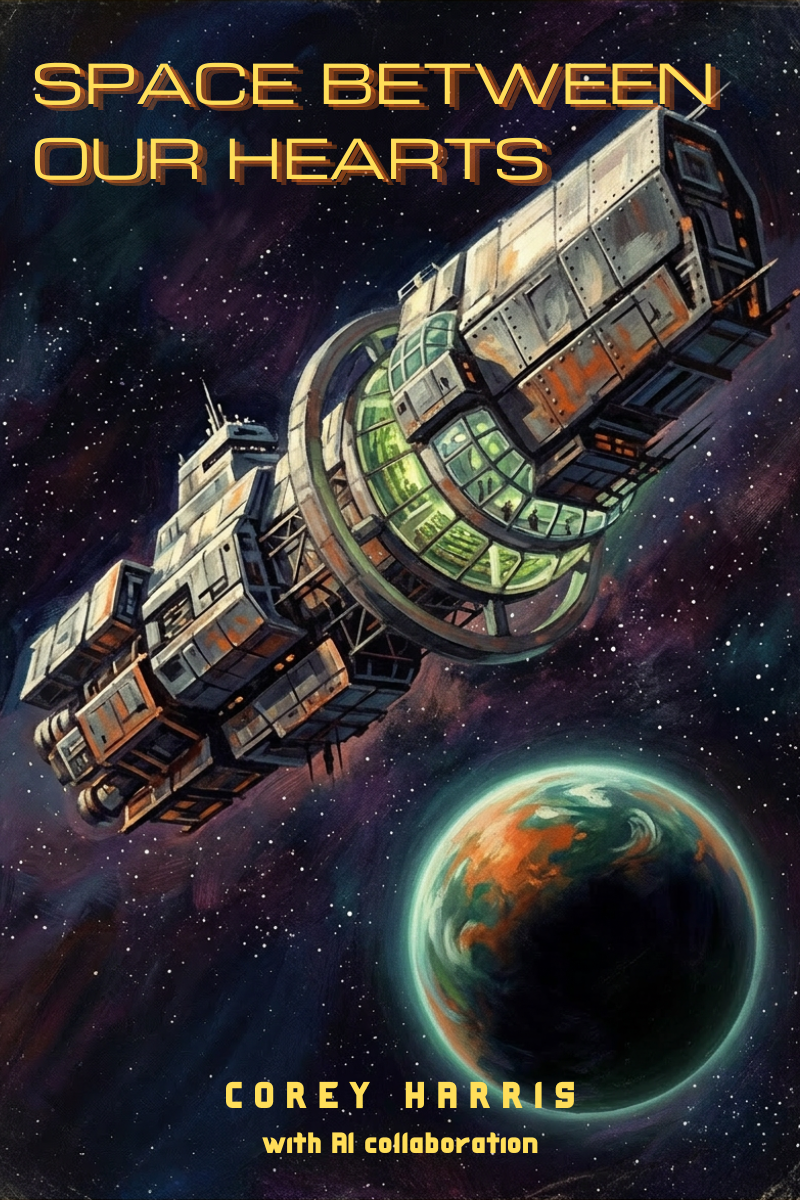
Space Between Our Hearts
Humanity has outgrown its home.
After expanding across the solar system—colonizing moons, building stations, and learning to survive beyond Earth—corporate coalitions launched the first true interstellar colony fleet. Not a mission of war or conquest, but of continuity. A calculated step toward ensuring humanity would endure.
Each ship was designed with purpose. Agriculture. Industry. Habitat.
Everything needed to build a new world.
Everything except uncertainty.
To preserve resources, crews live in rotating wake cycles: months awake, years asleep. Lives unfold in fragments. Time becomes something experienced alone.
Connections are designed. Meaningful ones are rare.
And yet, on one agricultural ship, two crew members begin to connect outside that design.
At first, it’s routine through the mechanical systems they maintain.
Then it becomes conversation.
Then something more.
They were never meant to meet.
They were never meant to choose each other.
They were never meant to fall in love.
But in a system designed for survival…
something unexpected begins to emerge.
Prologue
EARTH CULTURAL ARCHIVE
Educational Film — Circa 1962
“Humanity and the Stars”
Throughout history, people believed they were at the center of everything.
First their world.
Then the heavens above it.
For a time, even the universe itself.
Of course, we know better now.
The Earth circles an ordinary star, and that star drifts through an ordinary galaxy.
And the universe is far too large and far too old to have arranged itself around the small blue world where we happened to begin.
Yet humanity has never quite stopped imagining itself at the center of things.
Perhaps one day we will travel to distant planets and discover strange new creatures. Dinosaurs of another world roaming beneath alien skies.
Perhaps children watching this program will grow up to walk among the stars themselves, wearing rocket packs or gravity boots, exploring strange new worlds in ships faster than anything we can build today.
Why, some of you may even become astronauts.
Though by the time you hear this, that may be an outdated term.
You may be called galactic pioneers.
Interplanetary colonists.
Or perhaps…
Star Men.
But if that day ever comes, if humanity spreads beyond Earth and builds new homes around distant suns, we may discover something curious.
Even as we settle new worlds, we may still measure everything from where we began.
Humans on another Earth circling another star may count their own seasons, their own days, their own years. But somewhere in the records, those numbers will still be translated.
Back to Earth years.
Their distance from their sun, or from their home here on Earth, may be measured in units far greater than miles. Yet they will still be compared to the measurements that meant so much to us for so long.
So many things may be measured differently.
But they will all point back to one thing.
Back to the original reference.
Not because Earth is the center of the universe.
But because it was the center of ours.
Perhaps that is simply how people understand the world.
Everyone builds their life around a center.
For children, the center of the universe is their parents.
As they grow older, that center expands outward, to friends, to communities, to the places where they begin to build their own lives.
And sometimes, if they are lucky…
the center becomes one other person.
Cycle 0
Civilian Intake — Boarding Window
24 Hours to Launch
The staging facility hung in the outer reaches of the solar system like a small city built from glass and steel. Somehow temporary and permanent. Beyond its massive observation windows, the colony fleet waited in silent formation.
Five ships drifted against the black. The finishing touches were being completed on another five almost identical ships in the distance, systems cycling through final checks, approving themselves faster than anyone could follow. These would be the second wave to follow.
They were enormous.
Each one long and narrow, designed less like spacecraft and more like floating industrial complexes. From this distance they looked elegant, but the scale was difficult to grasp. Elias knew each vessel carried hundreds of people and enough equipment to build the foundation of a civilization.
Drones had already gone ahead years earlier—automated scouts sent to prepare the destination system. They mapped the planets, searched for hazards, and transmitted the last useful data humanity would receive before the fleet disappeared into interstellar space.
Once the ships left the solar system, communication with Earth would fade into static.
The next message home would come from another star.
Inside the staging hall, hundreds of people moved between cargo pallets and loading ramps. The air buzzed with conversation and nervous excitement.
Every department wore different uniforms.
Engineering wore gray.
Agriculture wore green.
Habitat systems wore blue.
Medical wore white.
The military had their own set of uniforms, and their own ship. Their job was to escort the fleet and keep the peace when everyone arrived.
From a distance it looked like a moving patchwork of color flowing across the polished floor.
Elias stood with the engineering group, hands in the pockets of his jacket, watching through the window as a transport tug drifted away from one of the ships.
“Hard to believe we’re actually doing this,” someone behind him said.
Elias didn’t answer. He had been waiting for this moment most of his adult life. And everything matched all of the models and designs he’d studied. That should have been reassuring.
A tone sounded over the speakers.
“Colonists, please proceed to the central briefing area.”
Rows of seats unfolded automatically from the floor as the crowd settled. The noise of conversation faded slowly.
A figure appeared on the large display at the front of the room.
It looked human.
Mostly.
“Good afternoon,” the figure said cheerfully. “I’m ARDEN, one of the mission coordination systems assigned to the Verdant Fleet.”
Someone in the audience whispered, “Party bot.”
ARDEN smiled as if it had heard the comment.
“My job is to help keep this trip organized, cohesive, and—whenever possible—pleasant.”
A few quiet laughs moved through the room.
Behind ARDEN, a diagram of the fleet appeared.
After centuries of government space programs, the expansion of humanity had finally been handed to the corporations that had built the infrastructure. And they were not being shy about putting their branding everywhere.
“This mission represents humanity’s first privately organized colonization effort beyond our solar system. Your destination is Tau Ceti, which is approximately twelve light-years from Earth. With current propulsion technology, the journey will take approximately forty-five years.”
Another diagram appeared, this time showing rotating crew groups.
“To conserve resources and maintain operational readiness during the voyage, the fleet operates on rotating wake cycles.”
The diagram rotated through colored sections.
“Each operational shift will remain active for approximately ten months before entering cryogenic suspension for fifty months.”
Murmurs moved through the crowd.
“For those concerned about aging,” ARDEN continued, “cryogenic suspension dramatically slows biological processes including aging.”
Someone behind Elias let out a low whistle.
The diagram changed again, now displaying clusters of names connected by thin lines.
“In addition to operational scheduling, this mission includes a new social stability initiative.”
The room grew quieter.
“Each colonist has been assigned a compatibility pairing.”
A few people exchanged looks.
“These pairings represent individuals with whom you are statistically most likely to form stable long-term partnerships.”
A hand went up somewhere in the back and someone shouted, “so we’re being assigned spouses?”
ARDEN tilted its head slightly.
“No.”
The answer was immediate.
“The compatibility system is not intended to control personal relationships.”
The display shifted again.
“It exists to improve the probability that the colony population will remain socially stable across multiple generations. Decades of data and research have been compiled to create the personality tests you took to qualify for this ship. In addition to ensuring your psychological health, it was used to build compatibility rankings for other members of the crew.”
A short pause.
“In simpler terms, the system isn’t about love.”
Another pause.
“It’s about the survival of humanity.”
The room sat quietly for a moment.
“If love emerges as a result of those conditions,” ARDEN continued, “we consider that an excellent outcome.”
A few people chuckled.
“Compatibility partners have been scheduled on similar wake cycles whenever possible. However, operational requirements may occasionally separate matched pairs.”
Another diagram showed overlapping shift groups.
“In those cases, colonists are encouraged to form relationships within their active community.”
Someone near Elias leaned toward a friend and whispered, “so basically frontier dating.”
ARDEN continued.
“You will spend the next hour meeting with your departmental coordinators. Afterward you will board your assigned vessels.”
The display faded.
“Welcome to the Verdant Fleet.”
A line of smaller text and logos appeared beneath the display, listing partner organizations in fine print.
The seating rows folded back into the floor as people stood.
Departments began organizing themselves almost immediately.
Colored uniforms gathered into loose formations.
Agriculture.
Engineering.
Medical.
Habitat systems.
Elias moved toward the engineering line.
Someone brushed against his shoulder.
He turned instinctively.
A woman about his age had collided with him while trying to move through the growing crowd.
“Sorry,” she said quickly.
“It’s fine,” Elias replied.
For a second they both hesitated, caught in the awkward pause of two strangers trying to move in opposite directions.
She smiled.
Hopeful.
“Maybe we’ll see each other on the ship,” she said.
“Maybe,” Elias replied. “Uh… safe travels.”
She disappeared into the green uniforms of the agriculture division before he could say anything else.
Elias quickly turned away, embarrassed at the awkward exchange.
A few minutes later the boarding ramps opened.
Through the massive viewing windows, Elias finally saw the agricultural ship up close. The Verdant Fleet had been designed as a distributed colony. Each vessel carried a different piece of a future civilization.
Elias was on a floating farm.
It stretched for kilometers.
Cargo bays.
Hydroponic rings.
Radiator panels extending like enormous wings.
A light rail system ran the length of the vessel, visible through long transparent corridors.
It looked less like a spacecraft and more like a moving city.
One by one the departments began boarding.
Inside, the scale became harder to grasp. The corridors were wide enough to move equipment through, and signs directed people toward habitation sectors and cryogenic bays.
Elias followed the engineering group toward their assigned quarters.
Technicians were already preparing the cryosleep chambers.
“Engineering shift one. You’ve already been prepped on the initial shift. Once the station crews are finished and disembark, you’ll officially be in charge of this ship.”
“Engineering shifts two through six,” a supervisor called out.
Elias stepped forward.
“It’s your turn to sleep. You will get a refresher of orientation when you are awoken for your cycle and a two week overlap with the shift before you to ensure a proper hand off. For those on shift six, this ship may look very different to you when you wake up four years from now.”
Everyone got quiet.
The cryo pod opened with a soft hiss.
Across the room, another group of colonists was heading toward the transit rail.
Among them, a flash of green uniform disappeared around the corner.
Agriculture shift one was already starting their cycle.
Elias settled into the pod.
The lid lowered slowly.
Beyond the glass he could see technicians moving between the rows of chambers.
Somewhere deep inside the ship, the engines began preparing for acceleration.
The fleet was leaving the solar system.
And the voyage had begun.
Cycle 1
Orientation
Crew Quarters 2 - Mara Ionescu
540 Months to Tau CetiAC01-C01-M000“This room smells…new!” I said aloud to no one at all.
But it wasn’t the smell of clean, though it was clean. Clean was filtered air and sterilized surfaces and the sharp chemical bite of things that had been printed, sealed, and approved for human habitation. New was different. New smelled like polymers that had not settled yet, recycled fabric fresh from packaging, and metal that still had a hint of the finishing residues meant to protect it in storage.
I stood in the doorway with my duffel hanging from one shoulder and looked at the quarters that were supposed to be home for the next ten months. It was barren and too utilitarian for my tastes.
“Cozy,” a voice behind me said.
I turned and found another woman about my age balancing two bags against one hip, dark hair like mine but tied back in a knot that looked accidental but probably wasn’t. She leaned to look past me into the room, then gave a low whistle.
“Wow,” she said. “They really spared every expense.”
I laughed and stepped aside to let her in. “Can’t really complain about moving into a new apartment when you didn’t have to sign a lease.”
“True. Instead we committed to moving with our apartment to a new star system. Not sure which I prefer,” she said as she dropped her bags onto the lower bunk. “You’re taller than me so you get to do the climbing into bed.”
I smiled and stuck out my hand. “Mara.”
“Sana.”
We shook, then both stood there for a second, taking in the same thing from slightly different angles. Two bunks. Two lockers built into the far wall. A narrow sink. A mirror too small to be useful. A recessed shelf with a pair of reading lights. Under the lockers, a mounting rail where temporary storage bins could be clipped in while we were awake. When our cycle ended, the bins would be removed, sealed, cataloged, and stored until the next time we woke.
If there was a next time for the same room.
If there was a next time for us at all.
Nothing permanent. Nothing wasted.
“This is it?” Sana opened one of the lockers and looked inside. “Complete with LifeLoop towels.”
She rubbed one against her face like she was in one of their commercials. “Never leave Sol without one.”
Something about her made this feel less like a mission and more like a place I might actually belong.
“For personal belongings,” I said, reciting from orientation. “Anything not mission-essential gets archived during suspension. If you want sentimental clutter, you have exactly forty liters.”
She looked at me with inquisitive hazel eyes. Her face, round and full. The kind you get from living with little to no gravity for most of your life.
“You memorized the briefing?”
“When I’m anxious, I tend to notice and memorize everything.”
“That’s unsettling.”
“It’s a nightmare. Especially when you’re able to recall everything about any awkward social situation you’ve ever been in in great detail.”
“What color shirt was the person wearing during your first real kiss?” She shot off.
“Ben. Markins. Blond hair. Long and wavy. Acne. Blue shirt with red speckled patterns on it. First holiday party of the seasonal harvest I was allowed to...”
“I get it!” She interrupted.
“Yeah, sorry,” I said. “Sana. Roommate. Dark hair. Significantly shorter than me.”
I shot her a smile.
“You’re weird. I like that,” she said with a similar smile. “We’re going to get along.”
Her voice had this lightness to it that helped confirm that sharing a room was going to work.
I put my bag on the upper bunk and started unloading things into the locker. A change of clothes, a tablet, a paperback I had brought for no practical reason other than stubbornness, a framed print thin enough to survive transport. Not a photograph. Just an old illustration of trees in autumn, bright orange and red under a sky so blue it looked made up. I slid it against the back wall of the locker and adjusted it until it was straight.
Sana noticed. “You brought trees to the farm ship?”
“I thought it was on theme.”
“My hands get bored,” she said as she pulled out way too much yarn. “I’ll knit you a hat in no time.”
I looked at her hands comparing to mine. Boney, yet strong. The kind you get when you have to lug large containers around but still need gentle dexterity to transplant seedlings.
She pulled a soft storage cube from her bag and snapped it onto the wall rail. “So this is really it, huh?”
I knew what she meant. Not the room. The ship. The mission. The thing no orientation packet could quite explain because the human brain was not built to feel the shape of forty years all at once.
Outside these walls, the colony fleet was still maneuvering into final departure positions somewhere beyond the edge of the solar system. Beyond that, there would be acceleration, and then years of silence and machinery and routines, and eventually a star with a name most of us still said like it belonged in a textbook.
Tau Ceti.
No return trip. No visiting home. No plan B.
I sat on the edge of the bunk. “I think so.”
I tried to picture it all again. The images of the system we received from the advance drones. And the artist renderings. It all started to seem made up to me because I was going to get to see the real thing.
Sana nodded once, like she was reviewing an unofficial part of the contract she had already signed months ago. “Weird part isn’t leaving, though.”
“No?”
“It’s the fragments.”
I looked up at her.
She shrugged and sat across from me. “We’re doing this in pieces. Ten months awake, years asleep. Wake up, work, sleep, wake up somewhere further from home. It’s like agreeing to time travel but with paperwork.”
She said it lightly, but something about it stayed with me longer than it should have
I smiled. “That should’ve been in the recruitment material.”
“See the galaxy. Build a world. Experience time as administrative discontinuity.”
“That’s terrible.”
“It would’ve worked on me.”
It would have worked on me, too.
That was the strange thing no one said too loudly: almost everyone aboard had made peace with the distance, but the time was harder. Not because we would lose it. We wouldn’t, not really. Everyone would age more or less together according to ship time, waking in their assigned cycles, sleeping through the long quiet stretches in between. When we reached Tau Ceti, we would arrive in roughly the same human season of ourselves that we had left. Older, yes. But together. Continuous by the clock that mattered.
Earth would move on without us. Sol would become history while we slept through most of the trip.
But the ship would be our history now.
Our clocks. Our birthdays. Our arguments. Our gardens. Our dead, if there were any. Our future.
“Do you think it’ll feel normal?” I asked.
Sana considered that. “Eventually? I think anything feels normal if people have to live inside it long enough.”
That sounded true enough to be depressing, so I stood and changed the subject by asking whether she wanted the left or right side of the sink shelf. We were still sorting that out when the shipwide tone chimed overhead, followed by a calm voice.
“Cycle One personnel, this is ARDEN. Welcome aboard Verdant System Support Farm Ship Two. Civilian orientation will begin in Common Ring Three at 0900 shipboard. Transit maps are available on all personal devices. Please allow additional travel time. You are currently lost.”
Sana looked up. “Did the ship just insult us?”
“Augmental Mission Intelligence,” I said. “Supportive, not sentimental.”
“It’s funny.”
“It’s programmed to reduce stress.”
“Then I already trust it more than most managers.”
We joined the stream of crew moving through the habitation module and down toward the central transit line. The ship was too large to understand all at once. Corridors curved with the structure, opening into junctions where signs projected softly over intersections: Cryosleep, Commons, Agriculture Ring Access, Engineering Spine, Medical. New faces passed in clusters, carrying bags, talking too loudly, trying not to look overwhelmed.
At one point the corridor opened into a viewing gallery and I stopped without meaning to.
Beyond the glass, one of the hydroponic rings turned in slow, silent rotation.
From a distance it looked almost unreal. Bands of green and brown wrapped around the curve of the structure in layered terraces. Light panels stretched overhead in a clean white arc, broken here and there by the darker geometry of irrigation trusses and maintenance rails. I could see movement down there: station workers putting the final pieces of the puzzle together before they left us to oversee the farms.
It was the first thing on the ship that did not feel manufactured. Not because it wasn’t. Every leaf below that glass existed because someone designed a system to keep it alive between stars. But green did something to the mind. It made steel feel temporary.
“Okay,” Sana said quietly beside me. “That’s beautiful.”
I nodded.
“Good,” she added. “I couldn’t imagine living inside one of the other ships that are primarily machines.”
“You are inside a machine.”
“I know. I’m just glad it’s designed to grow a lot of things.”
Common Ring Three was already half full by the time we arrived. Tables had been folded into the walls to make room for rows of chairs. The lounge had windows facing inward toward another agricultural section, and the effect was bizarre and comforting at the same time, like attending a corporate seminar inside a greenhouse.
There was a table with a stack of cups next to a dispenser labeled CP electro-nutro blend. It smelled faintly like citrus.
A woman wearing a sharp suit greeted us from the stage. She wore the emblem of one of the corporations who helped fund this mission.
“Welcome to Move-In Day,” she said. “On behalf of Fleet Command, Civilian Council, and every department that will ask you to fill out forms before lunch, we’re glad you made it aboard.”
That got a few laughs.
“Everyone here on this ship represents the best of humanity. And I can speak for everyone here in Sol about how proud we are to be witness to the first true civilian colony fleet to permanently move beyond our star.”
She introduced herself with a big smile, reviewed the basics, then handed the floor to a succession of people representing command, medical, agriculture, engineering, and behavioral support.
Her pleasantries left as quickly as she did with the rest of the corporate liaison presumably to their transport back to more civilized space. The corporations weren’t actually traveling with us. Just their stuff.
Apparently interstellar optimism has its limits.
Our captain led the rest of the introduction.
Most of it was exactly what it needed to be: practical, brief, and designed to keep panic from turning into rumors.
Command gets us there safely.
Civilian representatives handle quality-of-life concerns, grievances, and noncritical disputes.
Department heads manage mission work.
ARDEN supports the ship, monitors systems, and enforces doctrine where necessary, but does not replace human judgment.
If ARDEN tells you no, it is because someone with more authority than you already decided the answer.
If you have emotional objections to that, Behavioral Support would be happy to schedule a session.
By the time they reached the part about wake-cycle continuity protocols, the room had relaxed enough to laugh in the right places.
“All rooms are temporary assignments,” the civilian rep said. “You are not decorating for the long term. Personal storage will be archived when your cycle ends. Please do not bolt furniture to walls, rewrite air-handling settings, or begin blood feuds over locker allocation.”
“Too late,” Sana muttered.
The captain continued. “The mission is built on stewardship. You are not keeping this place. You are taking care of it for the people who come after you.”
Something about that landed harder than the rest.
Maybe because it was the first honest sentence of the morning.
The months that followed settled into rhythm faster than I expected. I thought I would miss home, but this was a one way trip. And that became a part of life.
The ship became less about what it was built to do… and more about the people trying to live inside it, which I found oddly comforting. I learned the walking routes between quarters, commons, and the agricultural sections without checking the map. I learned which tables in the lounge had the best view into the closest tiers. I learned that one of the techs in pollinator control sang to the bee chambers when she thought no one could hear her. I learned that fresh tomatoes made people momentarily forget they were crossing interstellar space inside a rotating metal cylinder.
I learned that brand-new equipment could still be annoying.
That last part should not have surprised me. Humanity had managed to build a fleet capable of carrying civilization to another star, but we still apparently had not solved the ancient problem of things being assembled by whoever submitted the second-lowest bid and promised miracles on paper.
By month ten, I had a running list.
Most of it was small. Sensors drifting out of tolerance. A nutrient mixer that always claimed that it was clogged. One lighting strip in Sector C that flickered whenever someone in maintenance tapped into power through an adjacent rail. Nothing serious. Nothing even unusual, according to the people who had been in agricultural systems longer than I had.
Still, the ship was new. It offended me on principle.
The irrigation valve in 4C started sticking halfway through a routine inspection near the end of my shift cycle.
I found it because one of the lower beds was pulling uneven moisture and the basil tray next to it was getting overwatered for no good reason. The valve housing looked fine from the outside, which was somehow more insulting than if it had failed dramatically. I opened the access plate, checked the actuator, flushed the line, and found a tiny shard of manufacturing residue stamped with a Verdant marking so small it felt like a joke caught where it had no business being.
I held it up between two fingers and stared at it.
“Even on their flagship colony,” I muttered to the empty service corridor, “they cut corners.”
“Comment recorded,” ARDEN said pleasantly through the wall speaker.
I nearly hit my head on the valve housing. “That was not for the record.”
“Understood. Informal frustration is not part of the maintenance archive unless requested.”
“Good.”
“Procurement notification available upon request.””
I narrowed my eyes at the speaker. “You’re enjoying this too much for a stunted intelligence.”
“I am an Augmental Mission Intelligence.”
“Exactly.”
I cleared the obstruction, recalibrated the flow tolerance, and cycled the system twice until the readings leveled out. Problem solved. Probably. At least until some engineer in a future wake cycle told me I had done it wrong.
I wiped my hands on a rag, then opened the maintenance log on my tablet and entered the formal report. Before I closed it, I hesitated, then added an open note to Engineering.
Irrigation Valve 4C was sticking. Cleared manufacturing debris from the actuator housing and recalibrated local flow tolerance. It’s working now, but if this thing fails again, I’d like written confirmation that our great interstellar future was, in fact, assembled by the lowest bidder. We’re building something beautiful here.
— M. Ionescu
“People do not belong to time. Time belongs to whoever is left to name it.” - Old colony saying, probably
I looked at it for a second.
Then I sent it.
A stupid message. A joke tossed into the ship’s endless memory. Something for the engineering recap and no one else.
Maybe that was why I liked it.
On my last night before suspension, the quarters looked almost as bare as they had on the day we arrived.
My locker was empty except for the autumn print, which I held for a moment before leaving it stuck to the wall where it had lived for the past ten months. I wanted to leave a piece of me behind for the next group.
Sana was already asleep in medical prep, one step ahead of me in the shutdown schedule. The room we had laughed in, complained in, and briefly mistaken for home had gone back to being what it was designed to be: a temporary shelter between assignments.
I stood in the doorway one last time.
Nothing here belonged to any one person for long.
The room. The bunk. The locker. The corridor outside. Even the months behind me felt less like ownership than custody, as if I had only been trusted with this piece of the mission until someone else could take it.
Still, we left things.
A scuff on the floor by the lower bunk. A cup someone forgot in the commons. Basil growing evenly again in 4C. A stupid note for Engineering. A hundred tiny proofs that someone had been here and cared enough to make one small thing better before disappearing into sleep.
And my picture of the trees on the wall. Someone will wake up here. A gift to future me… or someone like me. Maybe that’s the same thing.
ARDEN’s voice came softly from the corridor. “Cryosleep preparation window closes in twelve minutes, Mara.”
“I’m going.”
I touched the frame once on my way out, a gesture so unnecessary it almost embarrassed me.
Then I followed the lights toward medical, toward suspension, toward the first missing years of my life.
Cycle 1 (Copy)
Orientation
540 months to Tau Ceti
“This room smells…new!” I said aloud to no one at all.
But it wasn’t the smell of clean, though it was clean. Clean was filtered air and sterilized surfaces and the sharp chemical bite of things that had been printed, sealed, and approved for human habitation. New was different. New smelled like polymers that had not settled yet, recycled fabric fresh from packaging, and metal that still had a hint of the finishing residues meant to protect it in storage.
I stood in the doorway with my duffel hanging from one shoulder and looked at the quarters that were supposed to be home for the next ten months. It was barren and too utilitarian for my tastes.
“Cozy,” a voice behind me said.
I turned and found another woman about my age balancing two bags against one hip, dark hair like mine but tied back in a knot that looked accidental but probably wasn’t. She leaned to look past me into the room, then gave a low whistle.
“Wow,” she said. “They really spared every expense.”
I laughed and stepped aside to let her in. “Can’t really complain about moving into a new apartment when you didn’t have to sign a lease.”
“True. Instead we committed to moving with our apartment to a new star system. Not sure which I prefer,” she said as she dropped her bags onto the lower bunk. “You’re taller than me so you get to do the climbing into bed.”
I smiled and stuck out my hand. “Mara.”
“Sana.”
We shook, then both stood there for a second, taking in the same thing from slightly different angles. Two bunks. Two lockers built into the far wall. A narrow sink. A mirror too small to be useful. A recessed shelf with a pair of reading lights. Under the lockers, a mounting rail where temporary storage bins could be clipped in while we were awake. When our cycle ended, the bins would be removed, sealed, cataloged, and stored until the next time we woke.
If there was a next time for the same room.
If there was a next time for us at all.
Nothing permanent. Nothing wasted.
“This is it?” Sana opened one of the lockers and looked inside. “Complete with LifeLoop towels.”
She rubbed one against her face like she was in one of their commercials. “Never leave Sol without one.”
Something about her made this feel less like a mission and more like a place I might actually belong.
“For personal belongings,” I said, reciting from orientation. “Anything not mission-essential gets archived during suspension. If you want sentimental clutter, you have exactly forty liters.”
She looked at me with inquisitive hazel eyes. Her face, round and full. The kind you get from living with little to no gravity for most of your life.
“You memorized the briefing?”
“When I’m anxious, I tend to notice and memorize everything.”
“That’s unsettling.”
“It’s a nightmare. Especially when you’re able to recall everything about any awkward social situation you’ve ever been in in great detail.”
“What color shirt was the person wearing during your first real kiss?” She shot off.
“Ben. Markins. Blond hair. Long and wavy. Acne. Blue shirt with red speckled patterns on it. First holiday party of the seasonal harvest I was allowed to...”
“I get it!” She interrupted.
“Yeah, sorry,” I said. “Sana. Roommate. Dark hair. Significantly shorter than me.”
I shot her a smile.
“You’re weird. I like that,” she said with a similar smile. “We’re going to get along.”
Her voice had this lightness to it that helped confirm that sharing a room was going to work.
I put my bag on the upper bunk and started unloading things into the locker. A change of clothes, a tablet, a paperback I had brought for no practical reason other than stubbornness, a framed print thin enough to survive transport. Not a photograph. Just an old illustration of trees in autumn, bright orange and red under a sky so blue it looked made up. I slid it against the back wall of the locker and adjusted it until it was straight.
Sana noticed. “You brought trees to the farm ship?”
“I thought it was on theme.”
“My hands get bored,” she said as she pulled out way too much yarn. “I’ll knit you a hat in no time.”
I looked at her hands comparing to mine. Boney, yet strong. The kind you get when you have to lug large containers around but still need gentle dexterity to transplant seedlings.
She pulled a soft storage cube from her bag and snapped it onto the wall rail. “So this is really it, huh?”
I knew what she meant. Not the room. The ship. The mission. The thing no orientation packet could quite explain because the human brain was not built to feel the shape of forty years all at once.
Outside these walls, the colony fleet was still maneuvering into final departure positions somewhere beyond the edge of the solar system. Beyond that, there would be acceleration, and then years of silence and machinery and routines, and eventually a star with a name most of us still said like it belonged in a textbook.
Tau Ceti.
No return trip. No visiting home. No plan B.
I sat on the edge of the bunk. “I think so.”
I tried to picture it all again. The images of the system we received from the advance drones. And the artist renderings. It all started to seem made up to me because I was going to get to see the real thing.
Sana nodded once, like she was reviewing an unofficial part of the contract she had already signed months ago. “Weird part isn’t leaving, though.”
“No?”
“It’s the fragments.”
I looked up at her.
She shrugged and sat across from me. “We’re doing this in pieces. Ten months awake, years asleep. Wake up, work, sleep, wake up somewhere further from home. It’s like agreeing to time travel but with paperwork.”
She said it lightly, but something about it stayed with me longer than it should have
I smiled. “That should’ve been in the recruitment material.”
“See the galaxy. Build a world. Experience time as administrative discontinuity.”
“That’s terrible.”
“It would’ve worked on me.”
It would have worked on me, too.
That was the strange thing no one said too loudly: almost everyone aboard had made peace with the distance, but the time was harder. Not because we would lose it. We wouldn’t, not really. Everyone would age more or less together according to ship time, waking in their assigned cycles, sleeping through the long quiet stretches in between. When we reached Tau Ceti, we would arrive in roughly the same human season of ourselves that we had left. Older, yes. But together. Continuous by the clock that mattered.
Earth would move on without us. Sol would become history while we slept through most of the trip.
But the ship would be our history now.
Our clocks. Our birthdays. Our arguments. Our gardens. Our dead, if there were any. Our future.
“Do you think it’ll feel normal?” I asked.
Sana considered that. “Eventually? I think anything feels normal if people have to live inside it long enough.”
That sounded true enough to be depressing, so I stood and changed the subject by asking whether she wanted the left or right side of the sink shelf. We were still sorting that out when the shipwide tone chimed overhead, followed by a calm voice.
“Cycle One personnel, this is ARDEN. Welcome aboard Verdant System Support Farm Ship Two. Civilian orientation will begin in Common Ring Three at 0900 shipboard. Transit maps are available on all personal devices. Please allow additional travel time. You are currently lost.”
Sana looked up. “Did the ship just insult us?”
“Augmental Mission Intelligence,” I said. “Supportive, not sentimental.”
“It’s funny.”
“It’s programmed to reduce stress.”
“Then I already trust it more than most managers.”
We joined the stream of crew moving through the habitation module and down toward the central transit line. The ship was too large to understand all at once. Corridors curved with the structure, opening into junctions where signs projected softly over intersections: Cryosleep, Commons, Agriculture Ring Access, Engineering Spine, Medical. New faces passed in clusters, carrying bags, talking too loudly, trying not to look overwhelmed.
At one point the corridor opened into a viewing gallery and I stopped without meaning to.
Beyond the glass, one of the hydroponic rings turned in slow, silent rotation.
From a distance it looked almost unreal. Bands of green and brown wrapped around the curve of the structure in layered terraces. Light panels stretched overhead in a clean white arc, broken here and there by the darker geometry of irrigation trusses and maintenance rails. I could see movement down there: station workers putting the final pieces of the puzzle together before they left us to oversee the farms.
It was the first thing on the ship that did not feel manufactured. Not because it wasn’t. Every leaf below that glass existed because someone designed a system to keep it alive between stars. But green did something to the mind. It made steel feel temporary.
“Okay,” Sana said quietly beside me. “That’s beautiful.”
I nodded.
“Good,” she added. “I couldn’t imagine living inside one of the other ships that are primarily machines.”
“You are inside a machine.”
“I know. I’m just glad it’s designed to grow a lot of things.”
Common Ring Three was already half full by the time we arrived. Tables had been folded into the walls to make room for rows of chairs. The lounge had windows facing inward toward another agricultural section, and the effect was bizarre and comforting at the same time, like attending a corporate seminar inside a greenhouse.
There was a table with a stack of cups next to a dispenser labeled CP electro-nutro blend. It smelled faintly like citrus.
A woman wearing a sharp suit greeted us from the stage. She wore the emblem of one of the corporations who helped fund this mission.
“Welcome to Move-In Day,” she said. “On behalf of Fleet Command, Civilian Council, and every department that will ask you to fill out forms before lunch, we’re glad you made it aboard.”
That got a few laughs.
“Everyone here on this ship represents the best of humanity. And I can speak for everyone here in Sol about how proud we are to be witness to the first true civilian colony fleet to permanently move beyond our star.”
She introduced herself with a big smile, reviewed the basics, then handed the floor to a succession of people representing command, medical, agriculture, engineering, and behavioral support.
Her pleasantries left as quickly as she did with the rest of the corporate liaison presumably to their transport back to more civilized space. The corporations weren’t actually traveling with us. Just their stuff.
Apparently interstellar optimism has its limits.
Our captain led the rest of the introduction.
Most of it was exactly what it needed to be: practical, brief, and designed to keep panic from turning into rumors.
Command gets us there safely.
Civilian representatives handle quality-of-life concerns, grievances, and noncritical disputes.
Department heads manage mission work.
ARDEN supports the ship, monitors systems, and enforces doctrine where necessary, but does not replace human judgment.
If ARDEN tells you no, it is because someone with more authority than you already decided the answer.
If you have emotional objections to that, Behavioral Support would be happy to schedule a session.
By the time they reached the part about wake-cycle continuity protocols, the room had relaxed enough to laugh in the right places.
“All rooms are temporary assignments,” the civilian rep said. “You are not decorating for the long term. Personal storage will be archived when your cycle ends. Please do not bolt furniture to walls, rewrite air-handling settings, or begin blood feuds over locker allocation.”
“Too late,” Sana muttered.
The captain continued. “The mission is built on stewardship. You are not keeping this place. You are taking care of it for the people who come after you.”
Something about that landed harder than the rest.
Maybe because it was the first honest sentence of the morning.
The months that followed settled into rhythm faster than I expected. I thought I would miss home, but this was a one way trip. And that became a part of life.
The ship became less about what it was built to do… and more about the people trying to live inside it, which I found oddly comforting. I learned the walking routes between quarters, commons, and the agricultural sections without checking the map. I learned which tables in the lounge had the best view into the closest tiers. I learned that one of the techs in pollinator control sang to the bee chambers when she thought no one could hear her. I learned that fresh tomatoes made people momentarily forget they were crossing interstellar space inside a rotating metal cylinder.
I learned that brand-new equipment could still be annoying.
That last part should not have surprised me. Humanity had managed to build a fleet capable of carrying civilization to another star, but we still apparently had not solved the ancient problem of things being assembled by whoever submitted the second-lowest bid and promised miracles on paper.
By month ten, I had a running list.
Most of it was small. Sensors drifting out of tolerance. A nutrient mixer that always claimed that it was clogged. One lighting strip in Sector C that flickered whenever someone in maintenance tapped into power through an adjacent rail. Nothing serious. Nothing even unusual, according to the people who had been in agricultural systems longer than I had.
Still, the ship was new. It offended me on principle.
The irrigation valve in 4C started sticking halfway through a routine inspection near the end of my shift cycle.
I found it because one of the lower beds was pulling uneven moisture and the basil tray next to it was getting overwatered for no good reason. The valve housing looked fine from the outside, which was somehow more insulting than if it had failed dramatically. I opened the access plate, checked the actuator, flushed the line, and found a tiny shard of manufacturing residue stamped with a Verdant marking so small it felt like a joke caught where it had no business being.
I held it up between two fingers and stared at it.
“Even on their flagship colony,” I muttered to the empty service corridor, “they cut corners.”
“Comment recorded,” ARDEN said pleasantly through the wall speaker.
I nearly hit my head on the valve housing. “That was not for the record.”
“Understood. Informal frustration is not part of the maintenance archive unless requested.”
“Good.”
“Procurement notification available upon request.””
I narrowed my eyes at the speaker. “You’re enjoying this too much for a stunted intelligence.”
“I am an Augmental Mission Intelligence.”
“Exactly.”
I cleared the obstruction, recalibrated the flow tolerance, and cycled the system twice until the readings leveled out. Problem solved. Probably. At least until some engineer in a future wake cycle told me I had done it wrong.
I wiped my hands on a rag, then opened the maintenance log on my tablet and entered the formal report. Before I closed it, I hesitated, then added an open note to Engineering.
Irrigation Valve 4C was sticking. Cleared manufacturing debris from the actuator housing and recalibrated local flow tolerance. It’s working now, but if this thing fails again, I’d like written confirmation that our great interstellar future was, in fact, assembled by the lowest bidder. We’re building something beautiful here.
— M. Ionescu
“People do not belong to time. Time belongs to whoever is left to name it.” - Old colony saying, probably
I looked at it for a second.
Then I sent it.
A stupid message. A joke tossed into the ship’s endless memory. Something for the engineering recap and no one else.
Maybe that was why I liked it.
On my last night before suspension, the quarters looked almost as bare as they had on the day we arrived.
My locker was empty except for the autumn print, which I held for a moment before leaving it stuck to the wall where it had lived for the past ten months. I wanted to leave a piece of me behind for the next group.
Sana was already asleep in medical prep, one step ahead of me in the shutdown schedule. The room we had laughed in, complained in, and briefly mistaken for home had gone back to being what it was designed to be: a temporary shelter between assignments.
I stood in the doorway one last time.
Nothing here belonged to any one person for long.
The room. The bunk. The locker. The corridor outside. Even the months behind me felt less like ownership than custody, as if I had only been trusted with this piece of the mission until someone else could take it.
Still, we left things.
A scuff on the floor by the lower bunk. A cup someone forgot in the commons. Basil growing evenly again in 4C. A stupid note for Engineering. A hundred tiny proofs that someone had been here and cared enough to make one small thing better before disappearing into sleep.
And my picture of the trees on the wall. Someone will wake up here. A gift to future me… or someone like me. Maybe that’s the same thing.
ARDEN’s voice came softly from the corridor. “Cryosleep preparation window closes in twelve minutes, Mara.”
“I’m going.”
I touched the frame once on my way out, a gesture so unnecessary it almost embarrassed me.
Then I followed the lights toward medical, toward suspension, toward the first missing years of my life.
Cycle 1 (Copy) (Copy)
Orientation
540 months to Tau Ceti
“This room smells…new!” I said aloud to no one at all.
But it wasn’t the smell of clean, though it was clean. Clean was filtered air and sterilized surfaces and the sharp chemical bite of things that had been printed, sealed, and approved for human habitation. New was different. New smelled like polymers that had not settled yet, recycled fabric fresh from packaging, and metal that still had a hint of the finishing residues meant to protect it in storage.
I stood in the doorway with my duffel hanging from one shoulder and looked at the quarters that were supposed to be home for the next ten months. It was barren and too utilitarian for my tastes.
“Cozy,” a voice behind me said.
I turned and found another woman about my age balancing two bags against one hip, dark hair like mine but tied back in a knot that looked accidental but probably wasn’t. She leaned to look past me into the room, then gave a low whistle.
“Wow,” she said. “They really spared every expense.”
I laughed and stepped aside to let her in. “Can’t really complain about moving into a new apartment when you didn’t have to sign a lease.”
“True. Instead we committed to moving with our apartment to a new star system. Not sure which I prefer,” she said as she dropped her bags onto the lower bunk. “You’re taller than me so you get to do the climbing into bed.”
I smiled and stuck out my hand. “Mara.”
“Sana.”
We shook, then both stood there for a second, taking in the same thing from slightly different angles. Two bunks. Two lockers built into the far wall. A narrow sink. A mirror too small to be useful. A recessed shelf with a pair of reading lights. Under the lockers, a mounting rail where temporary storage bins could be clipped in while we were awake. When our cycle ended, the bins would be removed, sealed, cataloged, and stored until the next time we woke.
If there was a next time for the same room.
If there was a next time for us at all.
Nothing permanent. Nothing wasted.
“This is it?” Sana opened one of the lockers and looked inside. “Complete with LifeLoop towels.”
She rubbed one against her face like she was in one of their commercials. “Never leave Sol without one.”
Something about her made this feel less like a mission and more like a place I might actually belong.
“For personal belongings,” I said, reciting from orientation. “Anything not mission-essential gets archived during suspension. If you want sentimental clutter, you have exactly forty liters.”
She looked at me with inquisitive hazel eyes. Her face, round and full. The kind you get from living with little to no gravity for most of your life.
“You memorized the briefing?”
“When I’m anxious, I tend to notice and memorize everything.”
“That’s unsettling.”
“It’s a nightmare. Especially when you’re able to recall everything about any awkward social situation you’ve ever been in in great detail.”
“What color shirt was the person wearing during your first real kiss?” She shot off.
“Ben. Markins. Blond hair. Long and wavy. Acne. Blue shirt with red speckled patterns on it. First holiday party of the seasonal harvest I was allowed to...”
“I get it!” She interrupted.
“Yeah, sorry,” I said. “Sana. Roommate. Dark hair. Significantly shorter than me.”
I shot her a smile.
“You’re weird. I like that,” she said with a similar smile. “We’re going to get along.”
Her voice had this lightness to it that helped confirm that sharing a room was going to work.
I put my bag on the upper bunk and started unloading things into the locker. A change of clothes, a tablet, a paperback I had brought for no practical reason other than stubbornness, a framed print thin enough to survive transport. Not a photograph. Just an old illustration of trees in autumn, bright orange and red under a sky so blue it looked made up. I slid it against the back wall of the locker and adjusted it until it was straight.
Sana noticed. “You brought trees to the farm ship?”
“I thought it was on theme.”
“My hands get bored,” she said as she pulled out way too much yarn. “I’ll knit you a hat in no time.”
I looked at her hands comparing to mine. Boney, yet strong. The kind you get when you have to lug large containers around but still need gentle dexterity to transplant seedlings.
She pulled a soft storage cube from her bag and snapped it onto the wall rail. “So this is really it, huh?”
I knew what she meant. Not the room. The ship. The mission. The thing no orientation packet could quite explain because the human brain was not built to feel the shape of forty years all at once.
Outside these walls, the colony fleet was still maneuvering into final departure positions somewhere beyond the edge of the solar system. Beyond that, there would be acceleration, and then years of silence and machinery and routines, and eventually a star with a name most of us still said like it belonged in a textbook.
Tau Ceti.
No return trip. No visiting home. No plan B.
I sat on the edge of the bunk. “I think so.”
I tried to picture it all again. The images of the system we received from the advance drones. And the artist renderings. It all started to seem made up to me because I was going to get to see the real thing.
Sana nodded once, like she was reviewing an unofficial part of the contract she had already signed months ago. “Weird part isn’t leaving, though.”
“No?”
“It’s the fragments.”
I looked up at her.
She shrugged and sat across from me. “We’re doing this in pieces. Ten months awake, years asleep. Wake up, work, sleep, wake up somewhere further from home. It’s like agreeing to time travel but with paperwork.”
She said it lightly, but something about it stayed with me longer than it should have
I smiled. “That should’ve been in the recruitment material.”
“See the galaxy. Build a world. Experience time as administrative discontinuity.”
“That’s terrible.”
“It would’ve worked on me.”
It would have worked on me, too.
That was the strange thing no one said too loudly: almost everyone aboard had made peace with the distance, but the time was harder. Not because we would lose it. We wouldn’t, not really. Everyone would age more or less together according to ship time, waking in their assigned cycles, sleeping through the long quiet stretches in between. When we reached Tau Ceti, we would arrive in roughly the same human season of ourselves that we had left. Older, yes. But together. Continuous by the clock that mattered.
Earth would move on without us. Sol would become history while we slept through most of the trip.
But the ship would be our history now.
Our clocks. Our birthdays. Our arguments. Our gardens. Our dead, if there were any. Our future.
“Do you think it’ll feel normal?” I asked.
Sana considered that. “Eventually? I think anything feels normal if people have to live inside it long enough.”
That sounded true enough to be depressing, so I stood and changed the subject by asking whether she wanted the left or right side of the sink shelf. We were still sorting that out when the shipwide tone chimed overhead, followed by a calm voice.
“Cycle One personnel, this is ARDEN. Welcome aboard Verdant System Support Farm Ship Two. Civilian orientation will begin in Common Ring Three at 0900 shipboard. Transit maps are available on all personal devices. Please allow additional travel time. You are currently lost.”
Sana looked up. “Did the ship just insult us?”
“Augmental Mission Intelligence,” I said. “Supportive, not sentimental.”
“It’s funny.”
“It’s programmed to reduce stress.”
“Then I already trust it more than most managers.”
We joined the stream of crew moving through the habitation module and down toward the central transit line. The ship was too large to understand all at once. Corridors curved with the structure, opening into junctions where signs projected softly over intersections: Cryosleep, Commons, Agriculture Ring Access, Engineering Spine, Medical. New faces passed in clusters, carrying bags, talking too loudly, trying not to look overwhelmed.
At one point the corridor opened into a viewing gallery and I stopped without meaning to.
Beyond the glass, one of the hydroponic rings turned in slow, silent rotation.
From a distance it looked almost unreal. Bands of green and brown wrapped around the curve of the structure in layered terraces. Light panels stretched overhead in a clean white arc, broken here and there by the darker geometry of irrigation trusses and maintenance rails. I could see movement down there: station workers putting the final pieces of the puzzle together before they left us to oversee the farms.
It was the first thing on the ship that did not feel manufactured. Not because it wasn’t. Every leaf below that glass existed because someone designed a system to keep it alive between stars. But green did something to the mind. It made steel feel temporary.
“Okay,” Sana said quietly beside me. “That’s beautiful.”
I nodded.
“Good,” she added. “I couldn’t imagine living inside one of the other ships that are primarily machines.”
“You are inside a machine.”
“I know. I’m just glad it’s designed to grow a lot of things.”
Common Ring Three was already half full by the time we arrived. Tables had been folded into the walls to make room for rows of chairs. The lounge had windows facing inward toward another agricultural section, and the effect was bizarre and comforting at the same time, like attending a corporate seminar inside a greenhouse.
There was a table with a stack of cups next to a dispenser labeled CP electro-nutro blend. It smelled faintly like citrus.
A woman wearing a sharp suit greeted us from the stage. She wore the emblem of one of the corporations who helped fund this mission.
“Welcome to Move-In Day,” she said. “On behalf of Fleet Command, Civilian Council, and every department that will ask you to fill out forms before lunch, we’re glad you made it aboard.”
That got a few laughs.
“Everyone here on this ship represents the best of humanity. And I can speak for everyone here in Sol about how proud we are to be witness to the first true civilian colony fleet to permanently move beyond our star.”
She introduced herself with a big smile, reviewed the basics, then handed the floor to a succession of people representing command, medical, agriculture, engineering, and behavioral support.
Her pleasantries left as quickly as she did with the rest of the corporate liaison presumably to their transport back to more civilized space. The corporations weren’t actually traveling with us. Just their stuff.
Apparently interstellar optimism has its limits.
Our captain led the rest of the introduction.
Most of it was exactly what it needed to be: practical, brief, and designed to keep panic from turning into rumors.
Command gets us there safely.
Civilian representatives handle quality-of-life concerns, grievances, and noncritical disputes.
Department heads manage mission work.
ARDEN supports the ship, monitors systems, and enforces doctrine where necessary, but does not replace human judgment.
If ARDEN tells you no, it is because someone with more authority than you already decided the answer.
If you have emotional objections to that, Behavioral Support would be happy to schedule a session.
By the time they reached the part about wake-cycle continuity protocols, the room had relaxed enough to laugh in the right places.
“All rooms are temporary assignments,” the civilian rep said. “You are not decorating for the long term. Personal storage will be archived when your cycle ends. Please do not bolt furniture to walls, rewrite air-handling settings, or begin blood feuds over locker allocation.”
“Too late,” Sana muttered.
The captain continued. “The mission is built on stewardship. You are not keeping this place. You are taking care of it for the people who come after you.”
Something about that landed harder than the rest.
Maybe because it was the first honest sentence of the morning.
The months that followed settled into rhythm faster than I expected. I thought I would miss home, but this was a one way trip. And that became a part of life.
The ship became less about what it was built to do… and more about the people trying to live inside it, which I found oddly comforting. I learned the walking routes between quarters, commons, and the agricultural sections without checking the map. I learned which tables in the lounge had the best view into the closest tiers. I learned that one of the techs in pollinator control sang to the bee chambers when she thought no one could hear her. I learned that fresh tomatoes made people momentarily forget they were crossing interstellar space inside a rotating metal cylinder.
I learned that brand-new equipment could still be annoying.
That last part should not have surprised me. Humanity had managed to build a fleet capable of carrying civilization to another star, but we still apparently had not solved the ancient problem of things being assembled by whoever submitted the second-lowest bid and promised miracles on paper.
By month ten, I had a running list.
Most of it was small. Sensors drifting out of tolerance. A nutrient mixer that always claimed that it was clogged. One lighting strip in Sector C that flickered whenever someone in maintenance tapped into power through an adjacent rail. Nothing serious. Nothing even unusual, according to the people who had been in agricultural systems longer than I had.
Still, the ship was new. It offended me on principle.
The irrigation valve in 4C started sticking halfway through a routine inspection near the end of my shift cycle.
I found it because one of the lower beds was pulling uneven moisture and the basil tray next to it was getting overwatered for no good reason. The valve housing looked fine from the outside, which was somehow more insulting than if it had failed dramatically. I opened the access plate, checked the actuator, flushed the line, and found a tiny shard of manufacturing residue stamped with a Verdant marking so small it felt like a joke caught where it had no business being.
I held it up between two fingers and stared at it.
“Even on their flagship colony,” I muttered to the empty service corridor, “they cut corners.”
“Comment recorded,” ARDEN said pleasantly through the wall speaker.
I nearly hit my head on the valve housing. “That was not for the record.”
“Understood. Informal frustration is not part of the maintenance archive unless requested.”
“Good.”
“Procurement notification available upon request.””
I narrowed my eyes at the speaker. “You’re enjoying this too much for a stunted intelligence.”
“I am an Augmental Mission Intelligence.”
“Exactly.”
I cleared the obstruction, recalibrated the flow tolerance, and cycled the system twice until the readings leveled out. Problem solved. Probably. At least until some engineer in a future wake cycle told me I had done it wrong.
I wiped my hands on a rag, then opened the maintenance log on my tablet and entered the formal report. Before I closed it, I hesitated, then added an open note to Engineering.
Irrigation Valve 4C was sticking. Cleared manufacturing debris from the actuator housing and recalibrated local flow tolerance. It’s working now, but if this thing fails again, I’d like written confirmation that our great interstellar future was, in fact, assembled by the lowest bidder. We’re building something beautiful here.
— M. Ionescu
“People do not belong to time. Time belongs to whoever is left to name it.” - Old colony saying, probably
I looked at it for a second.
Then I sent it.
A stupid message. A joke tossed into the ship’s endless memory. Something for the engineering recap and no one else.
Maybe that was why I liked it.
On my last night before suspension, the quarters looked almost as bare as they had on the day we arrived.
My locker was empty except for the autumn print, which I held for a moment before leaving it stuck to the wall where it had lived for the past ten months. I wanted to leave a piece of me behind for the next group.
Sana was already asleep in medical prep, one step ahead of me in the shutdown schedule. The room we had laughed in, complained in, and briefly mistaken for home had gone back to being what it was designed to be: a temporary shelter between assignments.
I stood in the doorway one last time.
Nothing here belonged to any one person for long.
The room. The bunk. The locker. The corridor outside. Even the months behind me felt less like ownership than custody, as if I had only been trusted with this piece of the mission until someone else could take it.
Still, we left things.
A scuff on the floor by the lower bunk. A cup someone forgot in the commons. Basil growing evenly again in 4C. A stupid note for Engineering. A hundred tiny proofs that someone had been here and cared enough to make one small thing better before disappearing into sleep.
And my picture of the trees on the wall. Someone will wake up here. A gift to future me… or someone like me. Maybe that’s the same thing.
ARDEN’s voice came softly from the corridor. “Cryosleep preparation window closes in twelve minutes, Mara.”
“I’m going.”
I touched the frame once on my way out, a gesture so unnecessary it almost embarrassed me.
Then I followed the lights toward medical, toward suspension, toward the first missing years of my life.
Cycle 1 (Copy) (Copy) (Copy)
Orientation
540 months to Tau Ceti
“This room smells…new!” I said aloud to no one at all.
But it wasn’t the smell of clean, though it was clean. Clean was filtered air and sterilized surfaces and the sharp chemical bite of things that had been printed, sealed, and approved for human habitation. New was different. New smelled like polymers that had not settled yet, recycled fabric fresh from packaging, and metal that still had a hint of the finishing residues meant to protect it in storage.
I stood in the doorway with my duffel hanging from one shoulder and looked at the quarters that were supposed to be home for the next ten months. It was barren and too utilitarian for my tastes.
“Cozy,” a voice behind me said.
I turned and found another woman about my age balancing two bags against one hip, dark hair like mine but tied back in a knot that looked accidental but probably wasn’t. She leaned to look past me into the room, then gave a low whistle.
“Wow,” she said. “They really spared every expense.”
I laughed and stepped aside to let her in. “Can’t really complain about moving into a new apartment when you didn’t have to sign a lease.”
“True. Instead we committed to moving with our apartment to a new star system. Not sure which I prefer,” she said as she dropped her bags onto the lower bunk. “You’re taller than me so you get to do the climbing into bed.”
I smiled and stuck out my hand. “Mara.”
“Sana.”
We shook, then both stood there for a second, taking in the same thing from slightly different angles. Two bunks. Two lockers built into the far wall. A narrow sink. A mirror too small to be useful. A recessed shelf with a pair of reading lights. Under the lockers, a mounting rail where temporary storage bins could be clipped in while we were awake. When our cycle ended, the bins would be removed, sealed, cataloged, and stored until the next time we woke.
If there was a next time for the same room.
If there was a next time for us at all.
Nothing permanent. Nothing wasted.
“This is it?” Sana opened one of the lockers and looked inside. “Complete with LifeLoop towels.”
She rubbed one against her face like she was in one of their commercials. “Never leave Sol without one.”
Something about her made this feel less like a mission and more like a place I might actually belong.
“For personal belongings,” I said, reciting from orientation. “Anything not mission-essential gets archived during suspension. If you want sentimental clutter, you have exactly forty liters.”
She looked at me with inquisitive hazel eyes. Her face, round and full. The kind you get from living with little to no gravity for most of your life.
“You memorized the briefing?”
“When I’m anxious, I tend to notice and memorize everything.”
“That’s unsettling.”
“It’s a nightmare. Especially when you’re able to recall everything about any awkward social situation you’ve ever been in in great detail.”
“What color shirt was the person wearing during your first real kiss?” She shot off.
“Ben. Markins. Blond hair. Long and wavy. Acne. Blue shirt with red speckled patterns on it. First holiday party of the seasonal harvest I was allowed to...”
“I get it!” She interrupted.
“Yeah, sorry,” I said. “Sana. Roommate. Dark hair. Significantly shorter than me.”
I shot her a smile.
“You’re weird. I like that,” she said with a similar smile. “We’re going to get along.”
Her voice had this lightness to it that helped confirm that sharing a room was going to work.
I put my bag on the upper bunk and started unloading things into the locker. A change of clothes, a tablet, a paperback I had brought for no practical reason other than stubbornness, a framed print thin enough to survive transport. Not a photograph. Just an old illustration of trees in autumn, bright orange and red under a sky so blue it looked made up. I slid it against the back wall of the locker and adjusted it until it was straight.
Sana noticed. “You brought trees to the farm ship?”
“I thought it was on theme.”
“My hands get bored,” she said as she pulled out way too much yarn. “I’ll knit you a hat in no time.”
I looked at her hands comparing to mine. Boney, yet strong. The kind you get when you have to lug large containers around but still need gentle dexterity to transplant seedlings.
She pulled a soft storage cube from her bag and snapped it onto the wall rail. “So this is really it, huh?”
I knew what she meant. Not the room. The ship. The mission. The thing no orientation packet could quite explain because the human brain was not built to feel the shape of forty years all at once.
Outside these walls, the colony fleet was still maneuvering into final departure positions somewhere beyond the edge of the solar system. Beyond that, there would be acceleration, and then years of silence and machinery and routines, and eventually a star with a name most of us still said like it belonged in a textbook.
Tau Ceti.
No return trip. No visiting home. No plan B.
I sat on the edge of the bunk. “I think so.”
I tried to picture it all again. The images of the system we received from the advance drones. And the artist renderings. It all started to seem made up to me because I was going to get to see the real thing.
Sana nodded once, like she was reviewing an unofficial part of the contract she had already signed months ago. “Weird part isn’t leaving, though.”
“No?”
“It’s the fragments.”
I looked up at her.
She shrugged and sat across from me. “We’re doing this in pieces. Ten months awake, years asleep. Wake up, work, sleep, wake up somewhere further from home. It’s like agreeing to time travel but with paperwork.”
She said it lightly, but something about it stayed with me longer than it should have
I smiled. “That should’ve been in the recruitment material.”
“See the galaxy. Build a world. Experience time as administrative discontinuity.”
“That’s terrible.”
“It would’ve worked on me.”
It would have worked on me, too.
That was the strange thing no one said too loudly: almost everyone aboard had made peace with the distance, but the time was harder. Not because we would lose it. We wouldn’t, not really. Everyone would age more or less together according to ship time, waking in their assigned cycles, sleeping through the long quiet stretches in between. When we reached Tau Ceti, we would arrive in roughly the same human season of ourselves that we had left. Older, yes. But together. Continuous by the clock that mattered.
Earth would move on without us. Sol would become history while we slept through most of the trip.
But the ship would be our history now.
Our clocks. Our birthdays. Our arguments. Our gardens. Our dead, if there were any. Our future.
“Do you think it’ll feel normal?” I asked.
Sana considered that. “Eventually? I think anything feels normal if people have to live inside it long enough.”
That sounded true enough to be depressing, so I stood and changed the subject by asking whether she wanted the left or right side of the sink shelf. We were still sorting that out when the shipwide tone chimed overhead, followed by a calm voice.
“Cycle One personnel, this is ARDEN. Welcome aboard Verdant System Support Farm Ship Two. Civilian orientation will begin in Common Ring Three at 0900 shipboard. Transit maps are available on all personal devices. Please allow additional travel time. You are currently lost.”
Sana looked up. “Did the ship just insult us?”
“Augmental Mission Intelligence,” I said. “Supportive, not sentimental.”
“It’s funny.”
“It’s programmed to reduce stress.”
“Then I already trust it more than most managers.”
We joined the stream of crew moving through the habitation module and down toward the central transit line. The ship was too large to understand all at once. Corridors curved with the structure, opening into junctions where signs projected softly over intersections: Cryosleep, Commons, Agriculture Ring Access, Engineering Spine, Medical. New faces passed in clusters, carrying bags, talking too loudly, trying not to look overwhelmed.
At one point the corridor opened into a viewing gallery and I stopped without meaning to.
Beyond the glass, one of the hydroponic rings turned in slow, silent rotation.
From a distance it looked almost unreal. Bands of green and brown wrapped around the curve of the structure in layered terraces. Light panels stretched overhead in a clean white arc, broken here and there by the darker geometry of irrigation trusses and maintenance rails. I could see movement down there: station workers putting the final pieces of the puzzle together before they left us to oversee the farms.
It was the first thing on the ship that did not feel manufactured. Not because it wasn’t. Every leaf below that glass existed because someone designed a system to keep it alive between stars. But green did something to the mind. It made steel feel temporary.
“Okay,” Sana said quietly beside me. “That’s beautiful.”
I nodded.
“Good,” she added. “I couldn’t imagine living inside one of the other ships that are primarily machines.”
“You are inside a machine.”
“I know. I’m just glad it’s designed to grow a lot of things.”
Common Ring Three was already half full by the time we arrived. Tables had been folded into the walls to make room for rows of chairs. The lounge had windows facing inward toward another agricultural section, and the effect was bizarre and comforting at the same time, like attending a corporate seminar inside a greenhouse.
There was a table with a stack of cups next to a dispenser labeled CP electro-nutro blend. It smelled faintly like citrus.
A woman wearing a sharp suit greeted us from the stage. She wore the emblem of one of the corporations who helped fund this mission.
“Welcome to Move-In Day,” she said. “On behalf of Fleet Command, Civilian Council, and every department that will ask you to fill out forms before lunch, we’re glad you made it aboard.”
That got a few laughs.
“Everyone here on this ship represents the best of humanity. And I can speak for everyone here in Sol about how proud we are to be witness to the first true civilian colony fleet to permanently move beyond our star.”
She introduced herself with a big smile, reviewed the basics, then handed the floor to a succession of people representing command, medical, agriculture, engineering, and behavioral support.
Her pleasantries left as quickly as she did with the rest of the corporate liaison presumably to their transport back to more civilized space. The corporations weren’t actually traveling with us. Just their stuff.
Apparently interstellar optimism has its limits.
Our captain led the rest of the introduction.
Most of it was exactly what it needed to be: practical, brief, and designed to keep panic from turning into rumors.
Command gets us there safely.
Civilian representatives handle quality-of-life concerns, grievances, and noncritical disputes.
Department heads manage mission work.
ARDEN supports the ship, monitors systems, and enforces doctrine where necessary, but does not replace human judgment.
If ARDEN tells you no, it is because someone with more authority than you already decided the answer.
If you have emotional objections to that, Behavioral Support would be happy to schedule a session.
By the time they reached the part about wake-cycle continuity protocols, the room had relaxed enough to laugh in the right places.
“All rooms are temporary assignments,” the civilian rep said. “You are not decorating for the long term. Personal storage will be archived when your cycle ends. Please do not bolt furniture to walls, rewrite air-handling settings, or begin blood feuds over locker allocation.”
“Too late,” Sana muttered.
The captain continued. “The mission is built on stewardship. You are not keeping this place. You are taking care of it for the people who come after you.”
Something about that landed harder than the rest.
Maybe because it was the first honest sentence of the morning.
The months that followed settled into rhythm faster than I expected. I thought I would miss home, but this was a one way trip. And that became a part of life.
The ship became less about what it was built to do… and more about the people trying to live inside it, which I found oddly comforting. I learned the walking routes between quarters, commons, and the agricultural sections without checking the map. I learned which tables in the lounge had the best view into the closest tiers. I learned that one of the techs in pollinator control sang to the bee chambers when she thought no one could hear her. I learned that fresh tomatoes made people momentarily forget they were crossing interstellar space inside a rotating metal cylinder.
I learned that brand-new equipment could still be annoying.
That last part should not have surprised me. Humanity had managed to build a fleet capable of carrying civilization to another star, but we still apparently had not solved the ancient problem of things being assembled by whoever submitted the second-lowest bid and promised miracles on paper.
By month ten, I had a running list.
Most of it was small. Sensors drifting out of tolerance. A nutrient mixer that always claimed that it was clogged. One lighting strip in Sector C that flickered whenever someone in maintenance tapped into power through an adjacent rail. Nothing serious. Nothing even unusual, according to the people who had been in agricultural systems longer than I had.
Still, the ship was new. It offended me on principle.
The irrigation valve in 4C started sticking halfway through a routine inspection near the end of my shift cycle.
I found it because one of the lower beds was pulling uneven moisture and the basil tray next to it was getting overwatered for no good reason. The valve housing looked fine from the outside, which was somehow more insulting than if it had failed dramatically. I opened the access plate, checked the actuator, flushed the line, and found a tiny shard of manufacturing residue stamped with a Verdant marking so small it felt like a joke caught where it had no business being.
I held it up between two fingers and stared at it.
“Even on their flagship colony,” I muttered to the empty service corridor, “they cut corners.”
“Comment recorded,” ARDEN said pleasantly through the wall speaker.
I nearly hit my head on the valve housing. “That was not for the record.”
“Understood. Informal frustration is not part of the maintenance archive unless requested.”
“Good.”
“Procurement notification available upon request.””
I narrowed my eyes at the speaker. “You’re enjoying this too much for a stunted intelligence.”
“I am an Augmental Mission Intelligence.”
“Exactly.”
I cleared the obstruction, recalibrated the flow tolerance, and cycled the system twice until the readings leveled out. Problem solved. Probably. At least until some engineer in a future wake cycle told me I had done it wrong.
I wiped my hands on a rag, then opened the maintenance log on my tablet and entered the formal report. Before I closed it, I hesitated, then added an open note to Engineering.
Irrigation Valve 4C was sticking. Cleared manufacturing debris from the actuator housing and recalibrated local flow tolerance. It’s working now, but if this thing fails again, I’d like written confirmation that our great interstellar future was, in fact, assembled by the lowest bidder. We’re building something beautiful here.
— M. Ionescu
“People do not belong to time. Time belongs to whoever is left to name it.” - Old colony saying, probably
I looked at it for a second.
Then I sent it.
A stupid message. A joke tossed into the ship’s endless memory. Something for the engineering recap and no one else.
Maybe that was why I liked it.
On my last night before suspension, the quarters looked almost as bare as they had on the day we arrived.
My locker was empty except for the autumn print, which I held for a moment before leaving it stuck to the wall where it had lived for the past ten months. I wanted to leave a piece of me behind for the next group.
Sana was already asleep in medical prep, one step ahead of me in the shutdown schedule. The room we had laughed in, complained in, and briefly mistaken for home had gone back to being what it was designed to be: a temporary shelter between assignments.
I stood in the doorway one last time.
Nothing here belonged to any one person for long.
The room. The bunk. The locker. The corridor outside. Even the months behind me felt less like ownership than custody, as if I had only been trusted with this piece of the mission until someone else could take it.
Still, we left things.
A scuff on the floor by the lower bunk. A cup someone forgot in the commons. Basil growing evenly again in 4C. A stupid note for Engineering. A hundred tiny proofs that someone had been here and cared enough to make one small thing better before disappearing into sleep.
And my picture of the trees on the wall. Someone will wake up here. A gift to future me… or someone like me. Maybe that’s the same thing.
ARDEN’s voice came softly from the corridor. “Cryosleep preparation window closes in twelve minutes, Mara.”
“I’m going.”
I touched the frame once on my way out, a gesture so unnecessary it almost embarrassed me.
Then I followed the lights toward medical, toward suspension, toward the first missing years of my life.